
Why it matters
The producer
Barberani grows on the Corbara hills at the edge of the Orvieto zone in south-western Umbria, looking down over the still surface of Lake Corbara. The estate was founded in 1961 by Luigi and Giovanna Barberani, and the founding carried two separate orientations from the start: Luigi toward indigenous Umbrian grapes, Giovanna toward sweet wines made from botrytised grapes. Both threads are still visible in the range today.
The estate covers roughly 80 hectares, with 50 given to vineyards and olive groves on the Corbara hillsides. No herbicides, no pesticides. Maurizio Castelli, one of central Italy's more travelled consultant oenologists, advises on production. The white range is anchored by Grechetto, the indigenous Umbrian grape that produces around 20,000 bottles a vintage. The red range is built on Sangiovese, with Polvento as the estate's most deliberate wine: a single-variety red where yields have been reduced, slowly and without intervention, over thirty years.
Place and vineyards
Where the wines begin
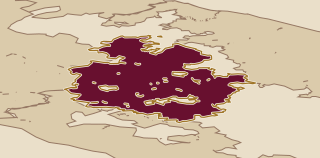
Orvieto sits on a flat-topped tuff cliff above the plain at the junction of Umbria and Lazio. The Corbara hills where Barberani farms lie just to the east, above the lake the Paglia river fills before joining the Tiber. The position matters: the lake moderates temperature, cooling the hillside vineyards in summer and extending the growing season into autumn. That extra time in the vineyard lets Grechetto ripen fully while holding its acidity. The hills also provide the drainage that Sangiovese needs to build colour and concentration rather than dilute.
Barberani's Grechetto carries the Umbria IGT label rather than the Orvieto DOC. That is a choice about grape variety and character: the Orvieto DOC is predominantly a blend appellation built on Trebbiano, and Barberani's white is a single-variety Grechetto. The IGT designation identifies the wine as Grechetto on the label.
In the cellar
Vineyards and cellar
All vineyards are farmed without herbicides or pesticides. Spontaneous grass cover is allowed to persist between rows, a practice that in the Polvento parcels has been running long enough to have measurably reduced yields over three decades. The competition for moisture in the hill soils concentrates sugars and polyphenols in the remaining fruit, which translates directly into Polvento's full body and its capacity to age.
Maurizio Castelli advises on production. Manual harvesting is practised across the estate. The Grechetto, produced at 20,000 bottles per vintage, is the volume wine and the one where timing is most precise: Grechetto picked at full ripeness on a cool hillside keeps the grape's natural bitter edge and medium body intact, and loses it quickly if the harvest is late.
Wines to know
The range in view
The white range rests on Grechetto Umbria IGT. It is the estate's largest production: around 20,000 bottles per vintage from the indigenous Umbrian grape. Grechetto is a mid-weight white with a characteristic slight bitterness on the finish, good natural acidity, and a texture that sits between lean and full. The Umbria IGT label signals single-variety vinification rather than the blended Orvieto DOC.
Polvento is the red the estate has put the most time into. One hundred percent Sangiovese, biodynamically inspired, with yields reduced gradually across thirty years through spontaneous grass competition rather than thinning or intervention. Full-bodied, concentrated, built for ageing. The grape here is the same Sangiovese that runs through central Italy, but the long yield-reduction programme shifts its register toward depth rather than volume.
A useful way in
A bottle to begin with
Start with Polvento. It is 100% Sangiovese from the parcels where spontaneous grass has been running for thirty years, and it carries every consequence of that commitment in the glass. The body is full, the tannins are genuine, and the dry dark-fruit mid-palate has the concentration that comes from vines working hard for limited fruit. There is no oak character obscuring the grape, no softening from international varieties. Pour it alongside something with some fat, something roasted or braised, and let it breathe for twenty minutes. It will not rush. That unhurried quality is exactly what thirty years of doing less looks like in a bottle.