
Why it matters
The producer
Barroca da Malhada sits in the village of Tinalhas, deep in Beira Interior, the high-plateau wine region of central Portugal. The estate was acquired in September 2021 by Fernando and Luciana Teixeira de Camargo, Brazilian siblings who chose this remote, continental corner of Portugal over more accessible options and immediately committed to biodynamic farming. The property they bought had once belonged to the Viscounts of Tinalhas and had fallen from productive use. Five hectares of vineyard now grow within a 17.5-hectare holding that also includes olive groves and cork oak trees.
The winemaking team is led by Fabio Fernandes, who joined in 2023, with Joaquim Barbosa as cellar manager. The estate is in certification transition and does not disclose production volumes. What it does disclose is a clear point of view: nine grape varieties hand-harvested, biodynamic soil management, and a cellar built around amphora, stainless steel, and chestnut barrels.
Place and vineyards
Where the wines begin
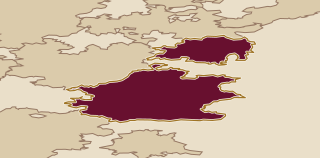
Beira Interior occupies the high inland plateau of central Portugal, east of the Serra da Estrela mountain range and close to the Spanish border. It is Portugal's most continental wine region: summers are hot and dry, winters sharp, and the altitude moderates what would otherwise be extreme ripeness. Vines here ripen slowly and hold their acidity longer than in lower coastal regions, which shapes the taut, mineral character the best Beira Interior reds carry.
The appellation covers three sub-zones: Castelo Branco, Cova da Beira, and Pinhel. Tinalhas sits in the Castelo Branco sub-zone, where the landscape opens into granite and schist outcrops and the elevation keeps growing seasons long. Labels from Beira Interior often highlight native Portuguese varieties, and the region has historically been a source for bulk production rather than estate bottlings. Small producers farming biodynamically and bottling under their own name remain unusual here.
In the cellar
Vineyards and cellar
Farming at Barroca da Malhada is organic and biodynamic, with minimum intervention as the stated principle for both vineyard and cellar. All nine varieties are hand-harvested, which on a five-hectare estate allows precise selection by parcel and ripeness. The sandy schist soils do not hold water, so biodynamic practice here focuses on building organic matter and microbial life in soil that would otherwise compact and lose fertility under conventional management.
In the cellar, the estate ages its wines across three vessel types: terracotta amphora, stainless steel, and chestnut barrels. Amphora is porous and oxygen-permeable, softening tannin and adding a faintly earthy, oxidative quality to the wine without the vanilla and wood flavours of oak. Stainless steel preserves fruit purity and acidity. Chestnut barrels, which were common in Portuguese winemaking before French and American oak became standard, add tannin and a lighter phenolic texture than oak. Using all three in a single wine draws different qualities from the same harvest rather than averaging them out.
Wines to know
The range in view
The range is built around native Portuguese varieties with one international grape in the mix.
The Vinho Tinto blends Trincadeira and Touriga Nacional, two of Portugal's most planted red grapes. Trincadeira brings dark fruit, spice, and relatively high alcohol in warm years; it is also susceptible to drought and rot, which makes biodynamic farming a meaningful choice for a grape that needs careful management. Touriga Nacional provides deep colour, floral perfume, and firm tannin. Together they make a wine with aromatic lift and firm tannin, aged across amphora, stainless steel, and chestnut barrels.
A useful way in
A bottle to begin with
Start with the Vinho Tinto. It is a Trincadeira and Touriga Nacional blend aged in amphora, stainless steel, and chestnut barrels, and it puts the estate's approach into a single bottle: native varieties, three-vessel ageing, minimum intervention, and the tight acidity of high-altitude schist farming. The aromas are violet, black cherry, and spice. The palate is firm-tannined with a bright acid line and a dry, firm finish. It is not a soft or approachable wine in the commercial sense; it is a wine that reflects where it comes from and what its makers chose to do with it.