
Why it matters
The producer
Bass Phillip is a small biodynamic estate in Gippsland, the long coastal region in eastern Victoria that curves toward the Bass Strait. Phillip Jones founded it in 1979 and spent the next twelve years farming before he released a single commercial bottle. His first vintage hit the market in 1991. By then the vineyards were planted to only two grapes, Pinot Noir and Chardonnay, and farmed without irrigation on a conviction that the site would speak clearly if the yields were kept low and the intervention in the cellar was kept to almost nothing.
The estate now covers roughly 14 hectares. It produces around 1,500 cases per year across three tiers. In 2020 Jean-Marie Fourrier, who runs Domaine Fourrier in Gevrey-Chambolle and had been connected to Bass Phillip for close to two decades, became the owner. He kept the farming and the cellar philosophy intact.
Place and vineyards
Where the wines begin
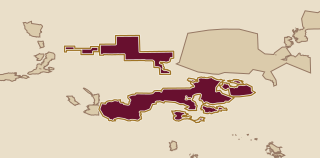
Gippsland sits in the south-eastern corner of Victoria, where the land drops toward Bass Strait and the Southern Ocean pushes a cool, moist maritime influence far inland. The region shares a latitude and a climate character with parts of Burgundy and northern Italy rather than with the warmer and better-known wine country of the Barossa or Hunter Valley. Summer temperatures stay moderate, ripening is slow, and the growing season stretches long enough for Pinot Noir to hold acidity while developing flavour. That combination of cool air and maritime humidity is exactly what Pinot Noir needs to produce wines with lift and definition rather than soft, ripe, broadly fruited bottles.
When Jones chose Gippsland in the late 1970s, very little serious Pinot Noir existed anywhere in Australia. He was reading the climate map, not following a regional reputation.
In the cellar
Vineyards and cellar
The 14 hectares are farmed biodynamically with no irrigation. Dense planting keeps individual vine yields low, and the picking decisions aim for full physiological ripeness without the sugar accumulation that comes with warm-climate harvests. Dry farming means each vintage reflects the actual season: cool years produce lighter, more aromatic wines; warmer years bring richer mid-palates while retaining the acidity that Gippsland delivers reliably.
In the cellar, the approach is minimal. The wines are unfined and unfiltered, passing from barrel to bottle without the treatments that strip character or soften texture. The 2021 Estate Pinot Noir aged 14 months in French oak with 22% new barrels, a proportion high enough to add some spice and frame without overwhelming the fruit character. No fining, no filtration. The wine arrives in the glass exactly as it left the barrel.
Wines to know
The range in view
Bass Phillip makes Pinot Noir and Chardonnay across three tiers: Estate, Premium, and Reserve.
Estate draws from the broader estate holdings. It spends around 14 months in French oak, with new oak kept at roughly 22%. It is a wine with immediate clarity: red cherry, rose petal, and a savoury bite of charred radicchio on the nose, then fine-grained tannin and fresh acidity through the palate. It is the most accessible tier and the one produced in the greatest volume across the roughly 1,500 annual cases.
A useful way in
A bottle to begin with
Start with Estate Pinot Noir. It is the tier where Bass Phillip's character is most legible: 14 months in French oak at 22% new, no fining, no filtration, and a nose that opens with red cherry, rose petal, charred radicchio, and spice before the palate delivers fine tannin and a clean acid line through to a dry finish. It is the least expensive and most available tier, and it already shows what Jones built and Fourrier has continued: Pinot Noir with cool-climate acidity, savoury complexity, and a dry, precise finish that has nothing in common with the soft, oak-driven styles that dominated Australian Pinot Noir for decades.