
Why it matters
The producer
Battenfeld Spanier farms 40 to 50 hectares of limestone soils in Hohen-Sülzen, a village in the Wonnegau subregion of Rheinhessen. Hans-Oliver Spanier took over his parents' winemaking operation in 1991 at nineteen. He merged it with the neighbouring Battenfeld estate in 1995 and converted the combined holding to biodynamic viticulture in 2005. The estate joined the VDP, Germany's association of classified-vineyard producers, in 2008. In 2011, it became a member of La Renaissance des Appellations, Nicolas Joly's international network of natural-farming estates.
All wines are fermented with the vineyard's own wild yeasts and finished dry. Riesling fills roughly 70% of the planted area. Spätburgunder accounts for approximately 18%, while Weissburgunder and Silvaner complete the range.
Place and vineyards
Where the wines begin
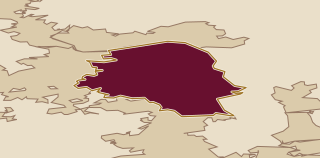
Rheinhessen is Germany's largest wine region by planted area. Most of the region sits on loess and clay soils in a broad, gently rolling basin west of the Rhine. Much of its wine is soft, commercial, and light. Hohen-Sülzen lies in the Wonnegau, a southeastern pocket of the appellation where the geology changes. Limestone lies close to the surface, and the Eisbachtal microclimate brings pronounced day-to-night temperature swings during the growing season. The Hohen-Sülzen Spätburgunder shows delicate salty minerality and a spicy, cool finish.
The VDP classification places this geography within a label hierarchy. Village-level bottles carry the Hohen-Sülzen name. Erste Lage bottles are classified as single named vineyards in the VDP's system and sit above the village tier. The Kirchenstück and Hohen-Sülzen Erste Lage designations both place the wine at this upper level. They carry stricter yield limits and the expectation of greater site expression.
In the cellar
Vineyards and cellar
Biodynamic farming at Battenfeld Spanier involves preparations made from plant and mineral materials. Field work is timed to lunar and cosmic cycles, and the soil biology is kept active rather than suppressed. Biodynamic farming is practiced in the vineyard. Fruit is harvested at physiological ripeness rather than chemical ripeness alone. The Kirchenstück old vines contribute to this naturally. Their roots reach deep into limestone, output per vine is low, and the berries are concentrated.
In the cellar, fermentation with native yeasts is standard. No commercial yeast strains are introduced. Fermentation proceeds at its own pace, driven entirely by the microflora the fruit brings in from the vineyard. The Rieslings are finished dry, with no dosage of sweetness. The Spätburgunder Erste Lage spends 18 months in French barrique before release.
Wines to know
The range in view
The range is built around two grapes and two tiers. Riesling, at 70% of plantings, produces both village-level and Erste Lage whites. The village Rieslings carry the Hohen-Sülzen designation and typically show the region's limestone freshness in a more open, immediate form. They offer bright citrus, firm acidity, and a clean, dry finish. The Erste Lage Rieslings from Kirchenstück and other classified parcels add depth and length. They have a tighter mineral core and mid-palate weight that rewards two or three years of bottle age.
Spätburgunder accounts for 18% of plantings and follows the same VDP tier hierarchy. The Hohen-Sülzen Spätburgunder Erste Lage is the estate's most argued red. It carries dark cherry fruit and barrel spice from 18 months in French oak, with a salty mineral thread through the mid-palate. The tannins are firm and polished rather than soft. The finish is cool and spicy rather than broad. Weissburgunder and Silvaner appear in smaller volumes. They are dry and fermented with vineyard yeasts like the rest of the range.