
Why it matters
The producer
Béres Vineyards and Winery planted its first vines in 2002 in Erdőbénye, a village near the southern edge of the Tokaj wine region in northeastern Hungary. The family came to the project not through inherited land or a commercial brief, but through attachment to Tokaj itself and to the particular character of the wines it produces. That motivation shaped an estate built from the ground up: 45 hectares farmed on volcanic tuff-loess soils, two native grapes at the centre, and a range that covers the full breadth of what Tokaj can make.
Winemaker János Jarecsni leads production. The estate's flagship parcel is the Lőcse dűlő, a single-vineyard Furmint site within the Erdőbénye estate whose rhyolite tuff-loess soils give the wine its mineral character. The range extends from dry Furmint and dry Hárslevelű through Szamorodni to Aszú, placing Béres across both the contemporary dry-wine revival and the sweet styles that made Tokaj famous across Europe for three centuries.
Place and vineyards
Where the wines begin
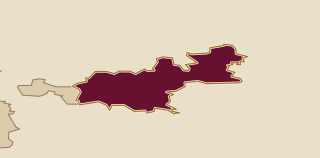
Tokaj is a UNESCO World Heritage wine region in the far northeast of Hungary, where the Bodrog and Tisza rivers create autumn mist that encourages noble rot on the Furmint grapes. The region's reputation rests on Aszú, a sweet wine made from botrytised berries selected by hand and measured in puttonyos, a unit counting the number of baskets of affected fruit added to the base wine. Tokaj also holds one of the oldest wine classifications in the world, predating Bordeaux's 1855 system by more than a century.
Erdőbénye sits toward the southern end of the Tokaj region, on hills where volcanic geology dominates. The landscape is hillside and valley, with parcels carved into slopes that catch afternoon sun and shed water quickly. Rhyolite tuff, the predominant volcanic rock here, holds warmth through the day and releases it slowly at night, extending the ripening window for Furmint and allowing the late-harvest timing that Aszú and Szamorodni both require.
In the cellar
Vineyards and cellar
The 45-hectare estate is farmed around Erdőbénye, with the Lőcse dűlő as the named single-vineyard parcel. Furmint and Hárslevelű are the two principal varieties across the estate.
Fermentation uses a combination of stainless-steel tanks and oak barrels, a method that allows the winery to preserve the fresh fruit and acidity of dry Furmint in tank while building texture through barrel contact in the same vintage. The Lőcse Furmint is aged on yeast sediment in traditional 215-litre zemplén oak barrels. These are small by Hungarian standards and specifically associated with the Zemplén hills that enclose the Tokaj region. Lees contact in that format softens the mid-palate and adds a creamy texture without covering the mineral line that the volcanic soil contributes. The small barrel volume limits the oak influence, keeping the wine's fruit and acidity at the front.
Wines to know
The range in view
Béres makes four styles, each occupying a distinct position in the Tokaj range.
The dry Furmint is the largest-volume tier, made to be drunk young or with a few years of bottle age. Furmint at this level delivers high natural acidity, white peach, apricot and citrus peel, with a clean finish shaped by the grape's natural phenolic grip.
A useful way in
A bottle to begin with
Start with the Béres Lőcse dűlő Furmint. It is a single parcel on rhyolite tuff-loess, aged on lees in 215-litre zemplén oak barrels, and it does the clearest job of connecting place, grape, and cellar method in one bottle. The acidity is high and firm, the fruit is stone rather than tropical, and the mineral quality is direct: there is a saline thread running from the nose through the finish that comes from the volcanic soil and goes nowhere else. The lees contact adds creaminess without covering that mineral line. This is what Tokaj Furmint tastes like when a single named parcel is treated with care.