
Why it matters
The producer
Bessa Valley farms 250 hectares of clay-limestone land near the village of Ognyanovo in Bulgaria's Thracian Valley, about 150 kilometres southeast of Sofia. Merlot covers more than half the planted area, with Syrah, Petit Verdot, and Cabernet Sauvignon filling the rest. The wines are sold under the Enira name: Petit Enira at entry level and a signature Enira blend above it.
The cellar is not built into the landscape so much as extracted from it. Workers carved it directly into a limestone hillside, and the rock walls still hold fossilised traces of a prehistoric seabed. Temperature and humidity remain naturally stable year-round, making refrigeration redundant for bulk ageing.
Place and vineyards
Where the wines begin
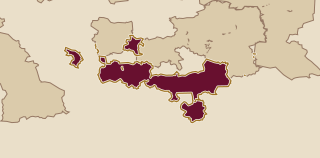
Ognyanovo sits in the Thracian Valley, the broad lowland plain that stretches across southern Bulgaria between the Balkan Mountains to the north and the Rhodope range to the south. The continental climate delivers hot summers and cold winters, with enough diurnal shift in autumn to slow ripening and preserve acidity in the fruit. At 150 kilometres from Sofia and well east of the capital, the valley is Bulgaria's largest and most export-oriented wine-producing zone.
The Thracian Valley label appears on bottles as a regional designation. For Bessa Valley, Ognyanovo is the physical address: a small village whose surrounding land carries clay-limestone soils deep enough to feed the Merlot vines through dry summers without losing grip on freshness.
In the cellar
Vineyards and cellar
Merlot vines on clay-limestone make up the backbone of the vineyard. Syrah brings darker fruit and a more peppery aromatic layer to the blends where it appears. Petit Verdot and Cabernet Sauvignon both contribute tannin and colour depth in smaller proportions, supporting the weight of the signature Enira without dominating the mid-palate.
In the cellar, the carved limestone environment keeps temperatures steady without mechanical intervention, which matters for oak ageing: barrels held in inconsistent conditions extract unevenly from the wood. The estate ages its wines in oak, and the fossil-embedded walls provide the stable backdrop for that process.
Wines to know
The range in view
The range runs across two levels. Petit Enira is the entry wine, and its composition moves between vintages depending on what the harvest provides. The 2019 is a Merlot-led blend with a substantial Syrah component: 58% Merlot, 36% Syrah, 4% Petit Verdot, and 2% Cabernet Sauvignon. The aromatic weight of Syrah gives the 2019 a darker, more savoury register. The 2020 abandons the blend entirely and returns to 100% Merlot, which shifts the palate toward red fruit clarity and a softer mid-palate.
Enira, the signature bottle, carries a different architecture: the 2019 is 42% Merlot, 36% Syrah, 12% Petit Verdot, and 10% Cabernet Sauvignon. Petit Verdot at 12% contributes colour intensity, firm tannin, and violet aromatics that the Petit Enira level does not carry. Cabernet Sauvignon at 10% adds tannin at the back of the palate. The Enira is an assembled, cellar-driven wine built for more development than its entry-level sibling.
A useful way in
A bottle to begin with
Petit Enira 2020. It is 100% Merlot from clay-limestone land in the Thracian Valley, aged in oak in a limestone cellar. On the nose, roasted spice and cinnamon. On the palate, red and dark fruit with lively acidity that lifts the finish and prevents the wine from sitting heavy. Tannins are measured. The cellaring arc runs to about 2027, and the wine will gain some mid-palate complexity as it develops. Start here: it is widely available, externally reviewed, and priced to be opened without deliberation.