
Why it matters
The producer
The vines at Bio Weingut Zahel grow inside one of the world's few capital cities that still takes wine seriously as agriculture. The estate farms 35 hectares across 95 separate parcels within Vienna's city limits, and it is run by Richard Zahel, now in the fourth generation of family ownership. Valentin Zahel has joined the operation, extending the family line into a fifth.
The estate holds two distinctions that sit at opposite ends of the historical spectrum. Its Wiener Gemischter Satz field blends follow a Viennese tradition of co-planting multiple grape varieties in a single vineyard and harvesting them together, a practice that predates modern appellation thinking by centuries. At the same time, in early 2024 Zahel became the first winery in Europe to receive Regenerative Organic Certification, a standard that goes beyond organic and biodynamic requirements to encompass soil health, farmer welfare, and land stewardship. The estate also produces the only mono-varietal Orangetraube wine in existence, bottled from a variety so rare that no other producer makes a varietal expression of it.
Place and vineyards
Where the wines begin
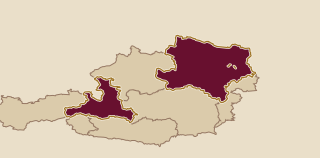
Vienna is unique among major wine regions because the vineyards are not outside the city or on its edge: they are inside it, threaded between districts, public parks, and residential streets. Zahel's 95 parcels are scattered across this urban landscape, with the Nussberg hill standing out as the estate's weightiest site. Vineyards within city limits sit under very different pressures from rural estates: no single contiguous block, a patchwork of exposures and soil types, and the logistical complexity of farming in a metropolis.
The Wiener Gemischter Satz DAC appellation formalises this urban wine tradition. A wine carrying that designation must come from a co-planted field blend grown within Vienna, with at least three grape varieties in the mix and no single variety exceeding 50 percent of the blend. The label is therefore both a geographic statement (Vienna) and a farming one (co-planted vineyard, harvested together).
In the cellar
Vineyards and cellar
The 35 hectares spread across 95 parcels within Vienna includes vineyards on the Nussberg hill and at Ried Kaasgraben, among other named sites. All vineyards have been certified organic since 2017 and biodynamic since 2018, meaning no synthetic pesticides, herbicides, or fertilisers, and farming guided by biodynamic preparations and calendar rhythms. The Regenerative Organic Certification achieved in early 2024 adds requirements around soil health monitoring and broader ecological stewardship.
The estate's production reaches approximately 135,000 litres per year. In the cellar, the Gemischter Satz wines are co-fermented from the mixed field harvests, so the blend is set in the vineyard, not at the tank. The Kaasgraben Wiener Gemischter Satz DAC is aged in ways that allow the wine to develop texture while preserving the freshness expected from Vienna's cooler urban parcels.
Wines to know
The range in view
The Gemischter Satz field blends form the core of the range. Because the DAC designation requires co-planting and co-harvest, each bottling reflects the specific vine composition of its named parcel rather than a post-harvest blend. The Ried Kaasgraben Wiener Gemischter Satz DAC is the estate's most prominent single-vineyard expression, showing the site's ageing potential alongside the freshness of the field blend.
The Nussberg Gemischter Satz occupies a different register. Planted with Weissburgunder, Chardonnay, and Neuburger, it carries noticeably more body than Vienna's lighter white tradition, with a Burgundian fullness that separates it from the crisper, more linear parcels elsewhere in the estate. The Orangetraube bottling stands apart from everything else in the range: a mono-varietal wine from a variety so uncommon that Zahel is the sole producer making a varietal expression of it anywhere in the world. The estate also operates a traditional Heuriger wine tavern, where the wines are served alongside homemade Viennese food, giving the estate an additional layer of local rootedness.
A useful way in
A bottle to begin with
Begin with the Ried Kaasgraben Wiener Gemischter Satz DAC. It is the estate's named single-vineyard field blend, grown within Vienna, co-harvested from co-planted varieties, and built to show both freshness and the capacity to develop with a few years in bottle. The wine brings citrus, white stone fruit, and herbal notes from the mixed planting, with a clean, lively acidity and enough texture to show that Vienna can make whites of genuine depth. It demonstrates the Gemischter Satz tradition at its most legible: one parcel, one harvest, multiple grape varieties expressing themselves as a single coherent wine.