
Why it matters
The producer
Pieter Walser owns no vineyards. He has never worked for another winemaker, never had a mentor, and built BLANKbottle entirely from direct experiment after founding it in 2004 in Firgrove, a small working area outside Somerset West in the Western Cape. That self-taught origin is not background detail. It is the operating condition of the range.
Walser sources fruit from 66 growers spread across the Western Cape, selecting each parcel on the basis of site character and what he wants to make that season. Up to 90 fermentations run simultaneously in his cellar, each spontaneous, each minimal-addition, each in a different vessel. The range shifts every vintage, running to 40 or 50 distinct wines. There is no house style to maintain and no flagship appellation to defend. Each wine is named individually, often after a personal encounter or a moment that mattered to Walser that year. Every label is drawn by hand and transferred to the bottle using old print shop methods. Walser draws every one himself.
Place and vineyards
Where the wines begin
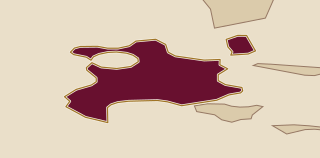
The Western Cape is not a single wine address. It is a broad administrative region encompassing the Stellenbosch, Swartland, Elgin, Hemel-en-Aarde, Walker Bay, and Franschhoek sub-regions, among others, each with its own soils, altitude, and maritime or continental climate character. Most producers anchor to one of these sub-regions and build a range around it. BLANKbottle does not. Walser's 66 growers are spread across this whole territory, which means any given vintage draws on slopes, valleys, and coastal plains with different drainage, temperature ranges, and vine age.
The consequence on the label is a Western Cape designation rather than a sub-regional one. There is no village appellation, no single district claim. The address is deliberately wide, and the wines carry that width: Bordeaux varieties from one corner of the Cape, Rhone whites from another, Chenin Blanc from a third. The blend of place into each wine is Walser's decision each year, not a fixed map.
In the cellar
Vineyards and cellar
Walser farms no land directly. He visits growers, selects fruit, and determines each year what he wants to work with and how. That sourcing model gives him flexibility unavailable to an estate producer: he can shift emphasis between sub-regions, drop a grower whose fruit no longer suits his direction, or add a new one whose parcel produces something he had not worked with before.
In the cellar, each parcel is fermented separately and spontaneously, with no commercial yeasts and minimal additions. The vessels are concrete egg, amphora, and oak, chosen per wine rather than uniformly applied. Up to 90 separate fermentations run simultaneously in a single vintage. Extended skin contact on the reds builds colour, tannin, and texture. The whites spend time on their lees in vessel before blending. Blending decisions come from tasting rather than formula. Walser assembles each wine by instinct against what the fruit is doing, and the final blends shift from year to year as a result.
Wines to know
The range in view
BLANKbottle does not publish a fixed range. The wines that appear each year depend on what Walser sourced, what each fermentation produced, and what he decided to bottle. Two wines illustrate the programme.
B.I.G. 2021 is a Western Cape red built predominantly on Cabernet Sauvignon, with Cabernet Franc, Petit Verdot, and Syrah completing the blend. Spontaneous fermentation with extended skin contact extracted deep colour and firm tannin from the Cabernet Sauvignon base. Eighteen months in French oak followed, building dried herb, cedar, and spice over the dark fruit core. Alcohol sits at 14.5%, acidity at 5.47 g/l. The wine is unctuous and full through the mid-palate, with blackberry and blueberry fruit carrying a leafy, herbaceous lift.
A useful way in
A bottle to begin with
Start with B. I. G. 2021. It is a Cabernet Sauvignon-led Western Cape red with Cabernet Franc, Petit Verdot, and Syrah completing the blend, fermented spontaneously with extended skin contact and aged eighteen months in French oak. The wine is dark and full, with blackberry, blueberry, dried herb, and a cedar finish. Tannins are firm but not hard. The unctuous mid-palate weight comes from the skin-contact extraction rather than from overripeness, and the herbaceous note from the Cabernet Franc cuts through the dark fruit and keeps the wine lively. At 14.5% it drinks with confidence but lands without heat.