
Why it matters
The producer
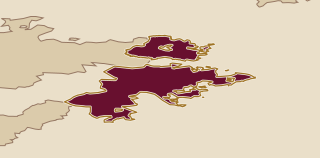
Rosana Madrid Romero spent years in front of a radio microphone before she walked away, studied viticulture, and planted a bodega in the high interior of Murcia. The estate she built sits in the El Carche valley at 1,372 metres above sea level, on the edge of the Sierra del Carche Protected Natural Park, within the Jumilla DO. Jumilla is an inland appellation in south-east Spain built on Monastrell, a thick-skinned, heat-tolerant red grape that produces wines of considerable depth at elevation. Seventeen hectares of vineyard feed a range that spans white, rosé, and red, from a single-variety Sauvignon Blanc to a four-variety flagship blend.
Rosana Madrid Romero came to wine by an unlikely route. Before the bodega, she worked in radio broadcasting. The decision to leave and study viticulture formally was not a retreat into a family business: her father farmed peppers in the Jumilla area, and the agricultural knowledge belonged to him, not to her. She acquired the winemaking knowledge herself, then built the estate on the edge of a protected natural park at altitude.
Place and vineyards
Where the wines begin
Jumilla is a dry, continental appellation where summer temperatures climb hard and rain is scarce, averaging around 300mm annually. At 1,372 metres in the El Carche valley, the estate sits above the worst of that heat. The elevation extends the growing season, slowing ripening through cooler nights and higher diurnal range, which means grapes arrive at harvest with more retained acidity than they would lower down the mountain. Monastrell responds well to these conditions: the grape already has dense skin and concentrated fruit, and the altitude keeps the acid line alive without softening the grape's natural richness. The Sierra del Carche Natural Park forms the backdrop on one side, and the land runs to 17 farmed hectares on the valley floor and slopes below it.
In the cellar
Vineyards and cellar
The 17 hectares in the El Carche valley carry Monastrell as the backbone grape, supported by Petit Verdot, Syrah, Cabernet Sauvignon, and Sauvignon Blanc. Production is described as manual and artisanal, with an annual output of around 30,000 bottles across the range. The cellar runs on solar energy, with water and waste systems designed for a dry-climate site where both resources are limited. No vine age, trellis system, harvest method, fermentation vessel, or ageing protocol has been sourced for the estate's standard range. The winery combines stated traditional methods with the infrastructure of a purpose-built facility.
Wines to know
The range in view
3 Calas Vitt (100% Sauvignon Blanc) opens the range as a light, aromatic white. Sauvignon Blanc is uncommon in Jumilla's Monastrell-dominated landscape, and at this elevation the grape holds enough freshness to read as a clean, herbal white with pear and citrus lift.
3 Calas Rosé (100% Petit Verdot) occupies a distinct position in the range and in the region. Petit Verdot is typically a blending grape in red wine production, and no other producer in Murcia had released a single-variety rosé from it before this estate did. The wine is pale in colour, fresh in character, and shows peach, ripe strawberries, orange peel, and spice. Petit Verdot at altitude produces more acidity than the grape achieves in warmer, lower-lying vineyards, and that freshness supports the aromatic intensity without weight.
A useful way in
A bottle to begin with
Start with the 3 Calas Rosé. It is 100% Petit Verdot, the first rosé produced from this grape in the Murcia region, and it puts the estate's most distinctive decision in the glass immediately. Petit Verdot is a blending grape in almost every wine region where it grows: thick-skinned, late-ripening, planted to add colour and tannic weight to red blends. Rosana Madrid Romero turned it into a standalone pale rosé at 1,372 metres, and the altitude makes the difference. The wine is pale in colour, fresh in acidity, and aromatic: peach, ripe strawberries, orange peel, and spice on a clean, fruity palate.