
Why it matters
The producer
Bodega Numanthia works from a narrow brief: one grape, one appellation, and old ungrafted vines on the high plateau of Zamora. Every bottle comes from Tinta de Toro, the local form of Tempranillo that grows thicker-skinned and deeper-coloured at this altitude than it does in Ribera del Duero or Rioja. The vines range from 30 to 200 years old and have never been grafted, survivors of the phylloxera louse that destroyed most of Europe's vine stock in the late nineteenth century.
The estate was founded in 1998 and acquired by Moët Hennessy in 2008, bringing it into the same ownership group as some of the most scrutinised estates in France. That context matters for understanding the investment in the vineyards, but the wines are built on the plateau, not in Paris. All farming across the estate is organic, and the winemaking philosophy is explicit: extract carefully and work the tannins in the right way.
Place and vineyards
Where the wines begin
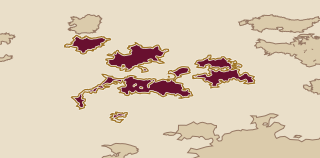
Toro is a Denominación de Origen in the province of Zamora, in the western reach of the Castilla y León plateau. The climate is sharply continental: winters cold enough to kill unprotected vines, summers hot enough to push alcohol high in thin-skinned grapes. Rainfall is low. Average altitude across the appellation sits above 600 metres, which pulls nights cool and slows ripening into autumn, preserving acidity that the summer heat would otherwise cook off.
The plateau soils are sandy, and that sandy texture is the reason the old ungrafted vines exist at all. The phylloxera louse that devasted European vineyards from the 1860s onward cannot travel or reproduce well in loose sandy ground. Where other Spanish regions lost their old vine stock and had to regraft onto American rootstock, Toro's sandy plateau kept its original plants. Numanthia's vine material is a direct consequence of that geology.
In the cellar
Vineyards and cellar
The vines are ungrafted and organically farmed. Yields from old vines are naturally low, concentrating sugar, colour, and tannin into fewer grapes per plant. Organic management rules out synthetic inputs, which on the dry plateau means vine stress is managed through pruning and canopy work rather than chemistry.
Tannin management is the stated centre of the winemaking approach. Rodriguez has described it directly: the only way to make a round wine is to work with the tannins in the right way. Extraction is controlled to achieve round tannins without stripping the wine of its density. The outcome is a tannin profile that is firm at the upper tiers but does not grip or dry the mouth. All three wines are aged in oak, though the time and barrel size vary by tier.
Wines to know
The range in view
Three dry red wines, all Tinta de Toro, all oak-aged, organised by vine age and parcel selection.
Termes is the entry wine. It draws cherry red in the glass, clean and brilliant. The nose is direct: black fruits, cinnamon, thyme, eucalyptus, toffee, and cacao in a medium-intensity aromatic register. On the palate, smooth tannins and fresh acidity carry the fruit without weight. Termes has an earlier drinking window than the wines above it and is built for accessibility without simplicity.
A useful way in
A bottle to begin with
Start with Termes. It is the wine that shows Tinta de Toro most directly: the dark fruit character, the herbal lift from thyme and eucalyptus, the smooth tannins that Numanthia's cellar approach makes its signature. The 2022 opens on black fruits and cinnamon, moves through a palate that is firm enough to feel serious and smooth enough to drink now, and finishes clean on fresh acidity. It does not demand years in the cellar or a long decant. For a first encounter with what Toro produces and what Numanthia does with it, Termes sets the ground more clearly than the higher tiers, where additional concentration and oak ask for more patience.