
Why it matters
The producer
Bodegas Abadía la Arroyada farms its own Tempranillo on family land in Terradillos de Esgueva, a village in the Burgos province of the Ribera del Duero DO. Every bottle in the range is estate-grown and 100% Tempranillo, built around the four quality tiers the appellation defines: Joven, Roble, Crianza, and Reserva.
The winery opened in 2002, but the vines were already old by then. Vicente Muñoz Muñoz's grandfather, Vicente Muñoz Vivar, had planted the original parcels and sold grapes commercially through most of the twentieth century. When Vicente Muñoz Muñoz decided to stop supplying other producers and put his own label on the wine, he was working with vines his grandfather had put in the ground decades earlier. That continuity runs through every cuvée.
Place and vineyards
Where the wines begin
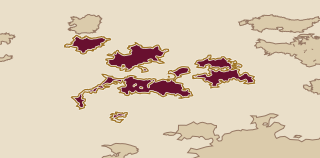
Terradillos de Esgueva sits in the western part of the Ribera del Duero DO, in Burgos province, on the high Castilian plateau roughly 800 metres above sea level. The Ribera del Duero appellation follows the Duero River east from Valladolid through Burgos and into Soria, and the elevation matters: summers are hot and dry, nights are cold, and the diurnal gap between daytime and overnight temperatures forces Tempranillo to ripen slowly and hold onto its acidity. That contrast is what gives Ribera del Duero Tempranillo its character: ripe dark fruit alongside firm tannin and enough freshness to sustain long oak aging.
For a wine from this address, the Ribera del Duero DO label on the bottle indicates that the wine is Tempranillo-dominant, grown on plateau land in continental conditions, and aged to appellation minimum standards before release. The tier (Joven, Roble, Crianza, Reserva) tells them how long in oak and how long in bottle before the wine left the winery.
In the cellar
Vineyards and cellar
All grapes come from the estate's own vineyards. No fruit is bought in. This single-source discipline means the wine in every bottle traces directly to the family parcels in Terradillos de Esgueva, with no blending from outside the property.
Fermentation is temperature-controlled across the range. The Tinto Joven is vatted for fifteen days at 22 to 26 degrees Celsius with no oak contact afterward, allowing the grape's primary fruit character to come through undisturbed. The Tinto Crianza uses an eighteen-day vat at 23 to 26 degrees Celsius before moving to oak aging: the slightly longer skin contact and tighter temperature band build more extract, giving the oak something to work with rather than dominate. The Reserva extends oak aging further, adding depth and persistence to the palate without losing the balance the range is built around.
Wines to know
The range in view
The range runs from unoaked to extended-oak through four tiers, all 100% Tempranillo.
Tinto Joven is the youngest wine: 14% alcohol, no oak, purple-red and bright in the glass. The nose is fresh and fruit-forward, with wild berry aromas, an unusual milky note, and a light spicy touch. The mouth is direct and uncomplicated, showing the grape without oak modification.
A useful way in
A bottle to begin with
Start with the Abadía la Arroyada Tinto Crianza. It is 100% Tempranillo from estate parcels in Terradillos de Esgueva, fermented for eighteen days at controlled temperature and aged in oak before release. Deep garnet in the glass. On the nose: ripe dark fruit with spice and a light toasted wood note, integrated rather than layered on top. On the palate: balanced, medium-bodied, with a finish that holds longer than the Roble without the weight of the Reserva. This is the wine where the house method becomes legible: how the controlled fermentation builds extract, and how the oak is folded into the fruit. If the Crianza lands well, the Reserva becomes the obvious next step.