
Why it matters
The producer
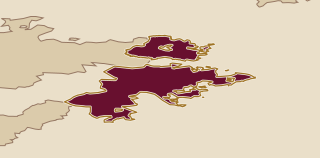
Yecla sits in the interior of Murcia, a small Denominación de Origen where most wine used to leave by the tanker rather than the bottle. Ramón Castaño Santa founded the winery in 1950 and committed to Monastrell, a thick-skinned grape that grew easily in the region's warm, dry conditions but was treated almost everywhere as a blending variety, valued for its deep colour and high alcohol rather than for what it could do on its own.
Castaño committed to Monastrell. Today the house farms close to 500 hectares entirely within the Yecla DO, with Monastrell covering roughly 80% of the planted area. Their three sons, Ramón, Juan Pedro, and Daniel, joined the enterprise and pushed the range into international markets. Winemaker Mariano López, with three decades at the cellar, has been the constant technical hand behind that expansion.
Place and vineyards
Where the wines begin
Yecla is a continental appellation: Mediterranean warmth moderated by altitude and distance from the coast, with dry summers and cool nights that slow ripening without stripping Monastrell of its characteristic dark fruit and body. The DO is compact and almost entirely planted with local varieties. Monastrell, known in France as Mourvèdre and in California as Mataro, achieves its densest, ripest character in Yecla's conditions, producing wines with deep colour, concentrated fruit, and enough warmth to carry oak ageing and the residual sweetness of the Dulce without tipping into heaviness.
Labels carry the Yecla DO designation. The appellation is not subdivided into villages or crus, so the individual sites Castaño farms distinguish the vineyards rather than from any official classification below DO level.
In the cellar
Vineyards and cellar
Monastrell vines cover roughly 330 hectares of Castaño's planted area, spread across the four named sites. The two cellar facilities divide the production work: an above-ground winery runs temperature-controlled fermentation in stainless steel tanks, allowing precise management of maceration for the dry reds. An underground barrel-ageing cellar, with controlled temperature and humidity, holds the oak programme.
For the Dulce Monastrell, the cellar uses eight months in a mix of French and American oak barrels. French oak tends to give finer grain and subtler spice; American oak brings a warmer vanilla character. The combination in the Dulce softens around the grape's natural dark fruit without overwhelming the sweetness-acidity balance between sweetness and acidity.
Wines to know
The range in view
Castaño's range is built almost entirely on Monastrell. The dry red tiers span from entry-level bottles to a premium range, all drawing from the same 500-hectare estate across limestone, stony, and clay parcels. The shift in soil between Las Gruesas and El Espinal is visible in the range: limestone-grown Monastrell gives darker fruit with a firmer tannin frame, while the clay-grown fruit at El Espinal tends to be rounder and more immediately approachable.
Dry Castaño Monastrell opens with dark berry fruit, the warmth of the Murcian interior in the growing season coming through as ripe plum and blackberry rather than fresh red fruit. The tannins are firm on limestone-grown fruit, broader on clay. Acidity holds the mid-palate together without sharpness; this is warm-climate wine that finishes cleanly because the variety has enough natural acid to carry the weight.
A useful way in
A bottle to begin with
Castaño Dulce Monastrell is a sweet red aged eight months in French and American oak barrels. It is a sweet red wine from estate Monastrell, fermented to retain natural sweetness, then aged eight months in French and American oak barrels. Deep cherry red, with candied black fruit and soft oak on the nose. The palate is concentrated, plum jam and dried fig, with a finish where acidity cuts through the sweetness cleanly. Serve it at 10 to 12°C, either alongside blue cheese or chocolate-based desserts, or simply by itself.