
Why it matters
The producer
Bodegas del Palacio de Fefiñanes makes only Albariño, draws it entirely from the Val do Salnés subzone of Rías Baixas, and has been doing so from the same seventeenth-century palace in Cambados since 1904. That founding date makes it one of Galicia's oldest commercial wineries. More specifically, it is the first producer to have commercially bottled and labelled a varietal Albariño wine, which it did in 1928, nearly sixty years before Rías Baixas received its DO classification in 1988.
Juan Gil de Araujo, Marqués de Figueroa and a former president of DO Rías Baixas, owns the estate. Winemaker Cristina Montilla joined in 1994 and has shaped the current range. The house works with approximately sixty contracted viticulturists across Val do Salnés and has built its reputation on a style that runs counter to the broader Rías Baixas tendency toward ripe, generous Albariño: pure, dry, acidity-driven, and saline.
Place and vineyards
Where the wines begin
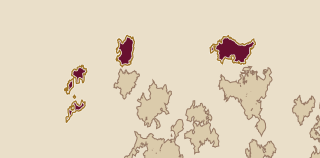
Val do Salnés is the westernmost and most Atlantic-facing subzone of Rías Baixas. Cambados sits at its heart, close to the coast and the Arousa estuary. The Atlantic proximity means frequent cloud cover, moderate temperatures and consistent humidity. Those conditions keep Albariño from accumulating excessive sugar, which in turn keeps alcohol measured and acidity prominent in the finished wine.
The appellation label reads Rías Baixas, but the wine comes from the Val do Salnés subzone. It is the subzone most closely associated with the grape's aromatic freshness and saline edge, both of which come from the combination of cool Atlantic air and the estuary's mineral influence. Fefiñanes works nowhere else.
In the cellar
Vineyards and cellar
The standard Albariño de Fefiñanes is fermented entirely in stainless steel and bottled in its first year. No oak contact. The goal is to deliver the aromatics of the Val do Salnés vintage cleanly: stone fruit, white blossom, mint and the saline freshness that the Atlantic proximity and old vines produce. Stainless steel preserves those characteristics without addition.
The III Año begins with cold soaking before fermentation, then spends thirty-six months on its lees. That extended contact builds texture and weight in the mid-palate, rounding the wine without softening its acidity. Val do Salnés keeps enough natural acid in the grape that three years of lees ageing does not flatten the wine; it deepens it.
Wines to know
The range in view
Three bottlings, one grape, one subzone, three very different results.
Albariño de Fefiñanes is the stainless-steel-only expression released in its first year. Aromatic and dry, it delivers stone fruit, white blossom and mint on the nose, then moves to a palate finely shaped by acidity, with saline freshness and a clean, mineral finish. The wine drinks well from release and continues to develop through three to five years. This is the range's most transparent expression of the Val do Salnés vintage.
A useful way in
A bottle to begin with
Begin with the standard Albariño de Fefiñanes. Fermented in stainless steel and released in its first year, it carries no oak, no extended ageing program, nothing between the Val do Salnés vintage and the glass. Stone fruit on the nose, white blossom, a thread of mint, and then a palate shaped almost entirely by acidity: dry, saline, with a mineral finish that holds. It is the clearest argument the house makes for Albariño as a dry, serious white wine rather than an aromatic crowd-pleaser. If that argument lands, III Año is the natural next step, adding thirty-six months of lees texture to the same foundation.