
Why it matters
The producer
Finca La Capilla sits in Roa de Duero, the market town at the geographic centre of the Ribera del Duero appellation in Castilla y León. The estate was founded in 1998 by the Forner family, which had already built wine businesses in Bordeaux, Rioja, and Rueda before a single vine was planted here.
The Forner connection to Bordeaux is not decorative. The family patriarch, Enrique Forner, purchased two classified Haut-Médoc châteaux in 1963 and worked within the French system for years before returning to Spain. That experience shaped how Finca La Capilla was built: a single block of 50 hectares farmed as one, a barrel cellar scaled to 2,000 casks, and a range architecture that treats the Crianza as a starting point rather than a volume wine.
Place and vineyards
Where the wines begin
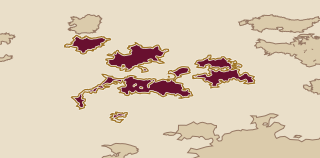
Ribera del Duero is a Denominación de Origen in the high interior of Castilla y León, where the Duero river cuts through a plateau sitting above 700 metres. The elevation keeps nights cool, protecting acidity through long, warm ripening seasons. Roa de Duero sits near the western boundary of the appellation, close to its administrative heart, and has been treated as the DO's central reference point since the appellation was established in 1982.
The local name for Tempranillo is Tinta del País, and the DO requires it to be the dominant grape in all red wines. That naming convention matters on a label: a Ribera del Duero red carries a different regional character from a Rioja Tempranillo even when the grape is the same variety, because the appellation implies the plateau climate, the altitude, and the characteristic combination of dark fruit and firm tannin that the Duero valley produces.
In the cellar
Vineyards and cellar
The 50-hectare vineyard block is farmed as an integrated estate, with the estate explicitly naming vineyard care and grape selection as the foundation of its quality approach. Identifying the best plots within the estate is described as a continuous process, not a fixed classification.
In the cellar, the Crianza spends 15 months in French oak before 16 to 20 months in bottle. French oak at this level gives the wine its toasted, creamy character without the heavier vanilla of American oak. The Vendimia Seleccionada uses new Bordeaux barrels alongside one-year-old French oak for 16 months, a combination that adds more new-wood extraction than the Crianza program and contributes the spice and exotic wood notes on the nose. After barrel aging, it rests in bottle for a minimum of 12 months before release.
Wines to know
The range in view
La Capilla Crianza is 98% Tinta del País with 2% Merlot. It is deeply coloured, with a glyceric, unctuous texture in the glass and fresh fruit on the nose wrapped in well-integrated oak. The palate is lively, with creamy, toasted notes and complexity. It is not a heavy or extracted wine by Ribera del Duero standards.
Vendimia Seleccionada is 99% Tinta del País with 1% Merlot, drawn from selected parcels across the estate. The nose is complex: black fruits, Chinese ink, liquorice, spice, and exotic wood. The palate is fruit-forward with complementary rather than dominant oak, and the finish is very long. The estate declares it suited for at least 10 more years of aging from release. The 16-month new Bordeaux barrel program and the extended bottle rest before release separate it clearly from the Crianza.
A useful way in
A bottle to begin with
La Capilla Vendimia Seleccionada is the bottle that shows what this estate is doing at full concentration. It is 99% Tinta del País from selected parcels, aged 16 months in new Bordeaux barrels and one-year-old French oak, then held in bottle for over a year before release. On the nose it delivers black fruit, liquorice, Chinese ink, spice, and the exotic wood character that new Bordeaux barrels give. In the mouth the fruit comes first, the oak works underneath it, and the finish is exceptionally long. It is a wine with genuine aging architecture, more than a bigger version of the Crianza.