
Why it matters
The producer
The three-syllable name at the top of the range, Pesus, carries something most wine labels do not: the compressed first syllables of two brothers. Pe, for Pedro. Sus, for Jesús. Together with their father Rafael, they founded Bodegas Hermanos Sastre in 1992 in La Horra, a village in the Ribera del Duero denomination in Burgos. The decision was to bottle their own wine from 23 hectares rather than sell grapes. The estate trades publicly as Viña Sastre.
Thirty-plus years later the family farms 55 hectares across La Horra and the neighbouring village of Roa, planted almost entirely to Tinto Fino on high-plateau land that averages around 800 metres above sea level. Vines here average over 60 years old. The organic and biodynamic commitment has been in place for more than three decades, well before sustainability became a marketing category in Spanish wine.
Place and vineyards
Where the wines begin
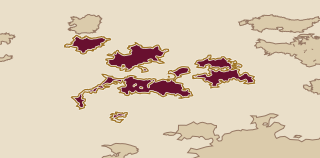
Ribera del Duero is a denomination that runs east to west along the Duero river through the high plateau of Castilla y León. The elevation sits between 750 and 900 metres, and the climate is emphatically continental: summer days reach 35 degrees Celsius while nights drop sharply, and winter is hard and long. That thermal gap is not only a climate fact. It is what drives natural acidity into the Tinto Fino, the local name for Tempranillo, slowing its ripening and keeping freshness in fruit that might otherwise turn heavy and flat at this latitude.
La Horra lies near the western end of the denomination. Soils here are a mix of limestone and clay over a chalky subsoil, and the combination of thin topsoil, low rainfall, and altitude stress the old vines into low yields. The resulting fruit is concentrated without losing lift.
In the cellar
Vineyards and cellar
Pruning follows lunar cycles, a traditional discipline preserved from the area's farming past and one the family believes keeps the vine in rhythm with its environment. Harvest runs ten days earlier than the regional norm. The earlier pick preserves acidity and avoids overripeness in the dark Tinto Fino fruit without sacrificing concentration in vines that have been deepening their root systems for six decades.
Fermentation across the range uses indigenous yeasts only. No commercial yeast starters. In the cellar, oak ageing scales with the wine: three-year-old barrels for the Roble, which spends six months in wood; new French oak for Pesus, with malolactic fermentation completed in barrel and 18 months of ageing before bottling. Pago de Santa Cruz Gran Reserva ages in new American oak and goes through four separate rackings, a labour-intensive process that progressively clarifies and settles the wine without filtration.
Wines to know
The range in view
The range is built around a single grape, Tinto Fino, with one white departure. Seven labels cover entry fruit to tribute-level prestige:
Roble spends six months in three-year-old barrels, keeping the oak light and the fruit forward. It is the accessible, early-drinking expression of the estate's old-vine Tinto Fino.
A useful way in
A bottle to begin with
Pago de Santa Cruz Gran Reserva is the right first bottle. It comes from the estate's oldest parcels, vines over 80 years old in La Horra, and the four-racking ageing in new American oak produces a wine with more visible complexity than the Crianza or Reserva while remaining genuinely available, unlike the sub-2,000-bottle Pesus. In the glass it opens with violet, red fruits in liqueur, nutmeg, and fennel on the nose, then moves to a palate that is broad, lively, and long, the tannins persistent but never coarse. It shows the altitude-driven freshness and the old-vine concentration that together define what the estate does: powerful Ribera del Duero that does not feel thick or inert.