
Why it matters
The producer
A stonemason founded this bodega in 1916. Juan Gil Giménez set up the winery in the heart of Jumilla, a landlocked appellation in Murcia, southeastern Spain, where the hills are high, the summers punishing, and Monastrell has been the working grape for centuries. That trade origin is not incidental: the family built something that has lasted across four generations, and the Jumilla house is now the headquarters of Viñas Familia Gil, a group of eleven wineries spread across ten Spanish wine regions.
What has not changed is the grape. Monastrell, thick-skinned and heat-adapted, drives every serious bottle in the Juan Gil range. The old bush vines grown in the hot, dusty hills of Jumilla produce dark-fruited, dense wines, and the family has positioned those wines at the centre of the group's regional wines across a century of expansion.
Place and vineyards
Where the wines begin
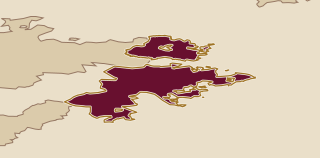
Jumilla is a DO appellation in the Murcia region, set inland from the Mediterranean coast and elevated enough that summer heat comes with cold nights. The combination accelerates ripening while preserving enough freshness to keep the wines from going flat. The appellation is built on Monastrell, a grape so well suited to the conditions that it dominates the vineyard landscape. Old bush vines, trained low and dry-farmed through decades of low rainfall, concentrate their fruit into small, thick-skinned berries.
The hills are genuinely arid: dusty limestone terrain where yields are low and the fruit arrives dark. That character goes straight into the bottle. A Jumilla Monastrell label tells you to expect weight, dark fruit, and a savory edge before you pull the cork.
In the cellar
Vineyards and cellar
The old bush vines in Jumilla's hills are dry-farmed, relying on the appellation's limited rainfall rather than irrigation. Bush vine training keeps the canopy low and close to the ground, where reflected heat from the pale soil helps ripen the thick-skinned Monastrell grape fully. Low yields from these old vines produce berries with concentrated color and flavor, which translates into the dark-fruited, full-bodied character of the Juan Gil reds.
In the cellar, the GOSA Organic Selection Monastrell sees oak aging, apparent in the palate's texture and a mild oak character alongside the primary dark fruit. The Silver Label Monastrell follows a similar approach to the fruit: old vine intensity and Jumilla heat as the primary drivers of the wine's weight and color.
Wines to know
The range in view
The range is led by Monastrell in two confirmed expressions and a white from Moscatel de Grano Menudo.
The GOSA Organic Selection Monastrell is 100 percent Monastrell from certified-organic vineyards. It carries the appellation's characteristic dark fruit, and the oak influence on the palate adds texture without overwhelming the grape. The wine sits at the entry level of the Juan Gil range and is the most widely distributed internationally.
A useful way in
A bottle to begin with
Start with the GOSA Organic Selection Monastrell. It is 100 percent Monastrell from certified-organic Jumilla vineyards, made by the founding house of a family that has been farming the appellation for over a century. The wine opens with dark cherry and forest raspberry, moves through herbs and black pepper, and closes with licorice and a mild oak thread. The body is full, the fruit is dense, and the savory finish is long. Nothing about it is complicated, but every element is Jumilla: the grape, the old vines, the dry hills, and the heat that concentrates all of it into the glass.