
Why it matters
The producer
Bodegas Lustau started not as a wine company but as a private stockholder. José Ruiz-Berdejo founded it in 1896, cultivating the family vineyard in Jerez and holding wine in cask rather than selling it commercially. That was the almacenista model: age wine quietly, sell it in bulk to larger houses, remain invisible to the market. Lustau spent its first decades that way.
The shift came in the 1940s, when Emilio Lustau put the family name on labels and began building the house as a commercial producer in its own right. A second change arrived in 1990, when the Luis Caballero Group acquired Lustau and brought the resources to scale what had been a careful, cask-led operation. In 2000 and 2001, Lustau acquired and relocated to six 19th-century bodega buildings on Calle Arcos in central Jerez, with cathedral-high ceilings and albero sand floors, concentrating 10,000 aging casks under one roof.
Place and vineyards
Where the wines begin
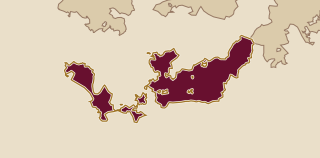
The Sherry Triangle sits in the far south of Spain, between the Atlantic coast and the inland heat of Andalusia. The three towns define it: Jerez de la Frontera is the heart, Sanlúcar de Barrameda sits where the Guadalquivir river meets the sea, and El Puerto de Santa María opens onto the Bay of Cádiz. Each location produces legally distinct wine because the climate differs measurably from one to the next.
Sanlúcar de Barrameda is the coolest and most humid of the three, kept that way by the Atlantic and the river estuary. That specific air is why Manzanilla is a separate appellation from Fino: the flor yeast that grows on the surface of the aging wine is thicker and more continuous in Sanlúcar than anywhere else in the Triangle, which keeps the wine paler, lighter, and more saline. A Manzanilla cannot be made in Jerez and carry that name. The label reflects the town.
In the cellar
Vineyards and cellar
Palomino Fino is harvested at moderate sugar levels and fermented to dry base wine before fortification. In the cellar, the division is between biological and oxidative aging, and that distinction governs the entire range.
Biological aging means the wine is fortified to around 15 percent alcohol and placed in partially filled casks, where a film of live yeast called flor grows on the surface. Flor consumes oxygen and protects the wine from air contact, keeping it pale and dry. In Sanlúcar, flor grows year-round because of the humidity; in Jerez, it thins in summer. Fino comes from Jerez; Manzanilla from Sanlúcar.
Wines to know
The range in view
The Solera Familiar range covers the core house styles. Fino del Puerto is a pale, dry Fino aged in El Puerto de Santa María under flor: light-bodied, with almond and bread aromas, clean and low in weight. Dry Oloroso brings the oxidative register: amber, nutty, concentrated, with a long and savoury finish that carries no residual sugar despite its depth.
The Almacenista collection is the house's most distinctive tier. Each wine is sourced from a single named small almacenista, bottled by Lustau with the original producer identified on the label. Styles span the full dry range: Manzanilla Pasada, Fino, Amontillado, Palo Cortado, and Oloroso, each from a different stockholder. The wines are often older and more individual than their counterparts in the core range, and the label carries both the almacenista's name and Lustau's.
A useful way in
A bottle to begin with
Manzanilla Papirusa is the right first bottle. It is 100% Palomino, aged under flor in Sanlúcar de Barrameda's cool, humid, Atlantic air, and it carries the character of that specific place more directly than anything else in the range.