
Why it matters
The producer
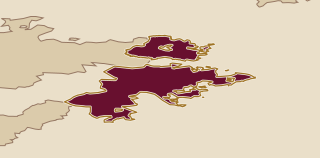
Bodegas Luzon farms 500 hectares of Monastrell in D.O.P. Jumilla, the appellation in southeastern Spain that runs across the border of Murcia and Castilla-La Mancha. It is one of the larger single-estate operations in the appellation, and its range covers the full vertical of what Jumilla Monastrell can do: a young, certified organic entry wine with four consecutive gold medals at the regional contest, and an old-vine flagship drawn from dry-farmed bush vines at 675 metres.
The estate was founded in 1841 by José de Molina on his return from naval service in the Philippines. He named it Finca Luzón after the Philippine island where he had served. For the next 140 years, the estate passed not through the male line but through the women of the Molina family, a lineage that held through Ana Josefa, Carmen Guillén, and Amparo Molina until close to the end of the twentieth century. The name on the label is both a naval memory and a family document.
Place and vineyards
Where the wines begin
Jumilla sits at altitude in the semi-arid interior of southeastern Spain. The appellation is built around Monastrell, the grape that the rest of the world knows as Mourvèdre, grown on calcareous soils under a continental climate with long, hot summers and dry winters. Annual rainfall is low enough that irrigation is not an option at the upper vineyard sites, and vines are dry-farmed by necessity.
The elevation at Bodegas Luzon ranges from 450 metres in the lower parcels to 600 metres across the main vineyard block, with the oldest vines sitting at approximately 675 metres. That altitude is not an aesthetic choice. Monastrell in hot lowland conditions loses its acidity fast and produces heavy, flat wine. At 600 metres and above, summer nights are cool enough to slow ripening and hold the acid line that keeps the wine alive in the glass. Harvest arrives later, the fruit is darker and more concentrated, and the acidity survives into the bottle.
In the cellar
Vineyards and cellar
The main vineyard block runs from 450 to 600 metres across calcareous terrain. Bush vine training, the traditional gobelet system, is standard at the older sites. The form keeps the canopy low and concentrated, reducing water loss in a dry climate and shading the fruit from the harshest afternoon heat. Yield per vine in old gobelet plots is small.
Dry-farming at the upper sites means no supplemental irrigation. Roots go deep. In dry years this produces smaller berries with higher skin-to-juice ratios, translating directly into deeper colour and firmer tannin in the wine.
Wines to know
The range in view
The range divides into two distinct tiers.
The Colección Monastrell anchors the accessible end: organically grown, unoaked, intended for early drinking. The wine is medium-to-full bodied with fine tannins and a bright acid line. The fruit is dark and direct, running from wild plum through dark cherry to blackberry, with floral violet and savory notes of tar, crushed stone, and nutmeg. Spice sits alongside fruit rather than dominating it. The wine scored 93 points from James Suckling and won gold at the Jumilla Wine Quality Contest in four consecutive years, repeated in the young red wines without wood contact category.