
Why it matters
The producer
The Oliver family has farmed the same land at Algaida without interruption since 1511. More than 15 generations have kept the same grapes in the ground: Prensal Blanc, Giró Ros, Callet, Gorgollassa, Manto Negro, Escursach. That continuity is not a marketing claim but a farming record, and it shapes what the wines are today: low-alcohol, organically certified, built entirely from varieties most of the wine world has never encountered.
The estate sits on the Possessió Binicomprat, a finca whose documented history reaches back to 1229 and the Mallorcan conquest period. The Oliver name is younger by nearly three centuries, but the land they have managed is among the most historically recorded agricultural properties on any Mediterranean island. The wines carry the DO Pla i Llevant label, a small Mallorcan appellation covering 450 hectares across 18 municipal areas, with 13 wineries producing under it.
Place and vineyards
Where the wines begin
Algaida sits at 265 metres on the flat central plain of Mallorca, El Pla, inland from the tourist coast and above the sea-level warmth of the island's lower terrain. The elevation matters: nights are cooler at 265 metres than on the coastal plain, and the diurnal gap slows ripening, keeping acidity alive into harvest.
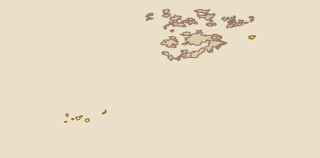
DO Pla i Llevant covers the central and eastern parts of the island. It is one of two main Mallorcan appellations, the other being DO Binissalem to the northwest. Pla i Llevant's 450 hectares are spread across 18 municipal areas, a wide footprint for a small denomination. The appellation permits both native and international varieties, though the producers who have built reputations here tend to lean on the indigenous cast.
In the cellar
Vineyards and cellar
Every variety is harvested by hand, with selection carried out in the vineyard rather than on a sorting table. The timing differs by variety and by the wine's destination: El Galgo, the estate's most ambitious red, is made from three separate harvests from the same vines at deliberately spaced intervals, building a layered phenolic profile that a single harvest date cannot achieve.
In the cellar, each variety is vinified separately before blending. For OM Blanc, Viognier, Prensal Blanc, and Giró Ros ferment together for six weeks in large-format first-year French oak barrels. The barrel size and the first-year oak limit the wood's contribution: the fermentation gains body and slight texture from the contact, but the oak does not dominate the fruit or add vanilla or toast characters. The white wine has more weight than a tank-fermented equivalent, without losing freshness.
Wines to know
The range in view
OM Blanc opens the range as a white blend of Viognier, Prensal Blanc, and Giró Ros, oak-fermented at 13 percent alcohol. The Viognier adds body and aromatic lift; the two native whites contribute the mineral and saline character the Binicomprat soils and embat wind generate. Six weeks of fermentation in large French oak gives the wine texture without making it heavy.
OM Giró Ros is a single-variety white from Giró Ros, a native Mallorcan grape so rarely planted elsewhere that it is effectively unknown outside the island. Whether made as still white or as rosé depends on the vintage. Its isolation from global viticulture means no reference point exists beyond Mallorcan estates.
A useful way in
A bottle to begin with
Start with OM Blanc. It is Viognier, Prensal Blanc, and Giró Ros, fermented for six weeks in large first-year French oak, at 13 percent alcohol. The oak fermentation gives the wine more presence than a simple tank-fermented white, a slightly rounded mid-palate and a texture that carries the aromatic weight of the Viognier without becoming rich or heavy. The two native Mallorcan varieties pull it toward mineral, herb, and the faint salinity the embat contributes across the growing season. It is a white wine with a clear sense of place at a moderate alcohol level, and it introduces the estate's core approach: native varieties, low intervention, and a microclimate doing visible work in the glass.