
Why it matters
The producer
Pazo Cilleiro sits beside the Romanesque Armenteira monastery in Meis, a municipality in the Val do Salnés sub-zone of Rías Baixas, on the Atlantic coast of Galicia. The name comes from a medieval monastic title. El Cilleiro was the monk assigned winery duties in the community: pressing grapes, ageing wine, managing every task that today belongs to an oenologist. That title became the bodega's name, and the monastery still stands adjacent to it.
The producer is not a single consolidated estate. It coordinates grapes from more than 250 independent winegrowers farming over 80 hectares across the sub-zone. All the vineyards are planted to Albariño, the grape that defines Val do Salnés, and all are trained on the pergola trellis traditional to Galicia. Two wines come from this network: a fresh, citrus-driven Albariño and a lees-aged Sobre Lías with broader texture.
Place and vineyards
Where the wines begin
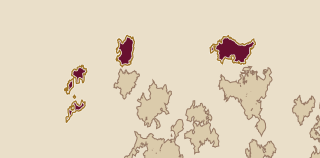
Val do Salnés is the northernmost and most Atlantic of Rías Baixas's five sub-zones, pressed close to the Galician coast between the estuaries that give the appellation its name. The Atlantic delivers high rainfall, persistent sea winds, and mild temperatures that keep acidity firm and ripeness moderate. That combination is what produces Albariño's characteristic freshness: aromatic and fruit-forward, yet taut and dry. The sub-zone is also the historical origin zone for the Albariño grape, which is why Pazo Cilleiro's labels carry the phrase "birthplace of Albariño."
The D.O. Rías Baixas appellation sits on the northwestern corner of Spain, a long way from the hot, dry inland meseta. The maritime climate means winemaking decisions in the vineyard centre on canopy management and disease prevention rather than drought or extreme heat.
In the cellar
Vineyards and cellar
Over 250 independent winegrowers tend the 80-plus hectares that supply Pazo Cilleiro's range, all within the Val do Salnés. The horizontal pergola, or parral, is the standard across every plot. The system is labour-intensive but climatically correct: the raised canopy lets Galicia's Atlantic rain and humidity drain and dry without saturating the grape clusters. Albariño is thick-skinned enough to handle the coastal conditions, but proper canopy management is what keeps the fruit clean and aromatic.
In the cellar, the main technical decision is the lees programme that separates the two wines. The entry Albariño is vinified for freshness and released without extended lees contact. The Sobre Lías wine rests on its fine lees after fermentation: the yeast sediment left in the vessel after primary fermentation adds weight to the mid-palate and supports the wine's freshness over time. The lees also round the citrus and tropical fruit notes that Albariño from Val do Salnés typically carries.
Wines to know
The range in view
The range is single-varietal and tight. Two bottles, both Albariño from the same network of 20 to 25 year old pergola-trained vines.
Pazo Cilleiro Albariño is the entry wine: dry, fruit-forward, with lime, yellow pear, green apple, pineapple, and cantaloupe melon alongside fresh floral notes and a firm, taut acid line. The acidity has a steely edge that keeps the fruit bright and the finish clean. It is built for early drinking and works well alongside white fish and shellfish.
A useful way in
A bottle to begin with
Pazo Cilleiro Sobre Lías is the bottle to open first. It is 100% Albariño from 20 to 25 year old pergola-trained vines in Val do Salnés, aged on fine lees after fermentation. The lees contact adds a soft texture to the mid-palate that the entry Albariño does not have, so the wine has a second layer: the citrus and tropical fruit are there, but so is a creamier body, and the coastal salinity and stony minerality become more distinct. It is dry, medium-bodied, and fresh, with a clean acid line and a finish that holds its mineral edge.