
Why it matters
The producer
Bodegas Ramon Ramos started underground, literally. Ramón Ramos took his father's winemaking knowledge into a subterranean cellar in Venialbo, a small village in the Zamora province of Castilla y León, and began making wine for local buyers. That cellar still stands on the property today, preserved as a museum while modern facilities operate beside it. Three generations later, the wines reach five continents.
The winery works within the Toro DO, one of Spain's more severe wine zones, where Tinta de Toro, the local Tempranillo, grows under extreme heat in summer and sharp cold in winter. The Ramos family grows its own grapes and divides its output across three clearly separated ranges, each drawing from a different tier of vine age on the same stony, sandy soils.
Place and vineyards
Where the wines begin
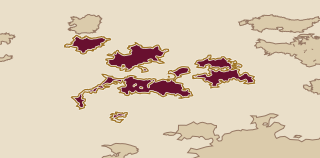
Toro DO sits in the western part of Castilla y León, inland and elevated, where the Duero river passes through a wide plateau. The climate is deeply continental: hot summers push ripeness quickly, cold winters rest the vines hard, and rainfall is low. These swings give Tinta de Toro the conditions it has adapted to over centuries: thick skins, concentrated fruit, and natural alcohol levels that run high without irrigation or forced ripening.
The DO label on a bottle from Toro signals Tinta de Toro as the primary grape. By appellation rule, red wines must use at least 75% of the variety, though most serious producers in the zone work at 100%. The appellation was officially recognised in 1987 and sits among a small group of Castilla y León DOs that have built reputations on a single indigenous grape.
In the cellar
Vineyards and cellar
Hand harvesting is the standard across the estate, and the reason is selection. Picking by hand allows the harvesters to leave behind anything that does not meet the quality threshold, a task that mechanical harvest cannot replicate. In a zone where summer heat can push grapes to uneven ripeness across a single parcel, the ability to choose individual clusters at the point of picking changes what arrives at the cellar.
The extreme seasonal climate is treated as a vineyard condition to work with rather than correct. Hot summers accelerate skin development and build the concentration that Tinta de Toro is known for; the cold that follows slows vine activity and preserves the acidity that keeps the wines alive in the glass. Both forces are present in every vintage, and both appear in the wines.
Wines to know
The range in view
Condesa de Ramos is the entry tier: fresh, fruity, and built for early drinking. The range includes one white wine made from Verdejo, a grape that in this context delivers bright, green-tinged aromatics and lively acidity, and red wines from younger Tinta de Toro vines. The style across Condesa de Ramos is light-footed and approachable, with fruit forward and tannin kept soft.
Monte Toro is the main range, six wines deep. These draw from vines aged 20 to 60 years and are shaped by the family's accumulated cellar knowledge across three generations. The approach blends traditional methods with modern techniques, prioritising fruit character and ageing potential together. The Monte Toro 8 Crianza 2020 is 100% Tinta de Toro at 15% ABV, organically certified, with a nose of violets, wild berries, dried herbs and white pepper, and a palate of fine, consistent tannins and a long, unhurried finish. Crianza designation in Toro DO requires a minimum of two years of ageing, including at least six months in oak, so these wines arrive with some cellar time behind them.
A useful way in
A bottle to begin with
Monte Toro 8 Crianza 2020 is the right first bottle from this estate. It is 100% Tinta de Toro, organically farmed, and carries the Crianza designation, which means it has spent time in oak and in bottle before release. On the nose: violets, wild berries, dried herbs, white pepper. In the mouth: fine tannins with good persistence, a steady acid line, and a finish that holds longer than the price suggests it should. The wine is full-bodied at 15% ABV but stays composed, showing what goblet-trained Tinta de Toro on sandy Zamora soils can produce when the cellar keeps things honest.