
Why it matters
The producer
Bodegas Santa Margarita farms 140 hectares of its own vineyards in Castilla-La Mancha and bottles under the Tierra de Castilla IGP, a geographic designation that covers a broad sweep of central Spain where the plateau climate allows for a wide range of grape varieties to ripen fully. The estate was founded in 2003, but the family's connection to vines runs considerably deeper. Their ancestors spent generations in vineyard plant nursery work, supplying rootstocks and young vines to other growers across the region. When the family founded the winery, they brought that rootstock-level knowledge of soil compatibility, variety behavior, and vine establishment into their own cellar for the first time.
Place and vineyards
Where the wines begin
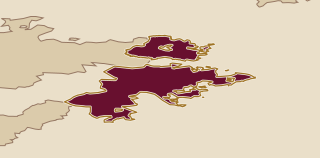
Tierra de Castilla is a protected geographic indication covering parts of Castilla-La Mancha, the elevated central plateau of Spain that sits roughly between Madrid and the southeastern coast. The designation is deliberately broad, covering a large and climatically varied area, and it appears on labels as a geographic marker rather than a guarantee of specific variety, soil type, or elevation. Wines labeled Tierra de Castilla can draw from a wide range of approved grapes, which explains why Santa Margarita cultivates thirteen varieties across both white and red styles without contradicting the label.
In the cellar
Vineyards and cellar
The estate operates modern winemaking facilities alongside traditional practices, a combination that in practical terms means contemporary temperature control and pressing equipment runs alongside cellar methods inherited from regional convention. A technical team monitors the vineyards through the growing season, following fruit development from bud break to harvest and adjusting the pick date for each variety independently. With thirteen grape varieties across white and red styles, the harvest calendar spreads across several weeks, and each variety arrives at the winery at the ripeness point suited to its range destination rather than to a single house style.
No confirmed barrel regime, lees time, or specific fermentation protocol is available for the Hoya Hermosa or Pasion Wines ranges. The cellar approach for Euforia Blue produces a light frizzante style with sufficient CO2 to give a soft mousse on the palate, chilled to between five and seven degrees Celsius for service.
Wines to know
The range in view
The estate's declared variety list runs to thirteen grapes. In white: Verdejo, Chardonnay, Sauvignon Blanc, and Macabeo. In red: Tempranillo, Merlot, Cabernet Sauvignon, Cabernet Franc, Garnacha, Pinot Noir, Petit Verdot, Monastrell, and Syrah. The breadth is a distribution strategy made visible in the vineyard: a lineup this wide can serve buyer preferences across European, Asian, and American markets without committing to a single variety as the estate's argument.
Hoya Hermosa is the premium tier, positioned as the award-winning line and carrying the highest price point in the portfolio. No confirmed tasting notes or variety breakdown per cuvée are available in verified sources.