
Why it matters
The producer
Ricardo de Santiago grew up in Benavente, a market town in the Zamora province with no wine tradition, and then drove east to Peñafiel and founded a winery. That is the biographical fact that sharpens everything else about Bodegas Tamaral: this is a first-generation winery, built from choice rather than inheritance, on one of the most argued stretches of the Ribera del Duero appellation.
Ricardo launched in 1997 with partners, including agronomists, and set the bodega on a course toward high-altitude Tempranillo from vineyards above 900 metres in Pesquera de Duero. At some point he and his wife Carmen bought out those partners entirely, and Tamaral became a wholly family-owned operation. Current winemaker Nicola Tucci leads production today.
Place and vineyards
Where the wines begin
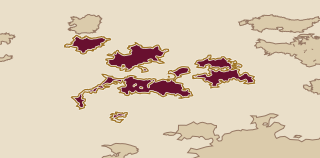
Ribera del Duero is a Spanish red wine appellation that follows the Duero river through Castilla y León, east of Valladolid and south of Burgos. The river defines the climate: warm days in summer, cold nights, and winters that arrive early. Peñafiel sits at the appellation's heart, and the stretch of road and vineyard running through the town is known as the Golden Mile, a cluster of bodegas that have made this the most commercially visible part of Ribera del Duero.
The practical wine consequence of this geography is Tempranillo grown under continental conditions: long, slow ripening that concentrates dark fruit, firm tannin, and acidity capable of carrying significant oak. Tamaral's vineyards in Pesquera de Duero, a village a few kilometres from Peñafiel, climb above 900 metres, where the altitude extends the growing season further and pushes acidity higher than lower-lying parcels.
In the cellar
Vineyards and cellar
The Tempranillo vineyards are in Pesquera de Duero, above 900 metres. Growing at that elevation delays ripening by several weeks compared to lower sites in the appellation, which gives the grapes longer on the vine and produces fruit with concentrated flavour and firmer acidity. The result in the glass is a wine that carries dark fruit with more firmness than warmer, lower Ribera del Duero sites tend to produce.
In the cellar, Tamaral ages its flagship Tempranillo blend in new 225-litre French oak barrels for a minimum of one year. New French oak at that duration leaves a significant mark: cedar, vanilla, and roasted barrel notes integrate with the dark cherry and plum fruit from the grape. The Cabernet Sauvignon component, at five percent of the blend, adds depth and colour stability without altering the fundamentally Tempranillo character of the wine.
Wines to know
The range in view
The core of the range is the Tamaral red, a blend of 95% Tempranillo and 5% Cabernet Sauvignon from high-altitude parcels in Pesquera de Duero, aged one year in new French oak at 14.5% alcohol. It sits in the Ribera del Duero entry-to-mid tier: big enough for serious food, old-vine dark fruit, and the roasted cedar and vanilla that come with the oak programme. Dark cherry, plum, blackcurrant, and notes of chocolate and cardamom run through the mid-palate.
Tamaral lists Crianza, Reserva, and Gran Reserva tiers in the Ribera del Duero range, each carrying longer ageing requirements under the appellation rules. Crianza requires a minimum of two years total ageing with at least one year in oak; Reserva extends that further; Gran Reserva further still. Each step typically brings more integrated oak, broader fruit complexity, and longer finish. Tamaral also produces an Albariño under the La Carmina label from Rías Baixas and a Verdejo from Rueda, extending the portfolio beyond Castilla y León, though the Ribera del Duero Tempranillo remains the bodega's central work.
A useful way in
A bottle to begin with
Start with the Tamaral 2023. It is 95% Tempranillo, 5% Cabernet Sauvignon, aged one year in new French oak from high-altitude Pesquera de Duero vineyards. The blend and the oak programme together show what Tamaral does: dark, concentrated Castilian Tempranillo with a clear roasted barrel signature. Dark cherry and plum are at the centre, chocolate and cedar frame the mid-palate, and the finish is long and warm. At 14.5%, it is a full-bodied wine and makes no attempt to be subtle about it. Open it an hour before dinner, serve with something slow-cooked, and you have the full picture of what Ribera del Duero Tempranillo from altitude tastes like at this price point.