
Why it matters
The producer
Juan Antonio Ponce returned to his home territory of Iniesta, in the Manchuela DO along the Cuenca-Albacete border, with a plan that made no commercial sense on paper. He was 23. His family had grown grapes there since 1953 and sold every harvest to the local cooperative. In 2005, Ponce borrowed roughly 60,000 euros, persuaded his father to break that arrangement, and started a winery with eleven barrels.
Manchuela at that moment was a cooperative region, producing bulk wine from Bobal, a grape with thick, hard tannins that the broader market had never taken seriously as a fine-wine variety. Ponce had trained under Telmo Rodríguez, working through Rioja, Toro, Gredos, Alicante and Ronda, watching what attentive farming and plot-by-plot cellar work could do in places that had also carried a bulk-wine reputation. He came back to Iniesta carrying those ideas and applied them to a grape nobody in his region had bet on.
Place and vineyards
Where the wines begin
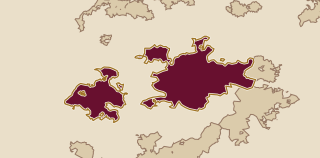
Manchuela DO sits on a high limestone plateau south-east of Madrid, straddling the provinces of Cuenca and Albacete in Castilla-La Mancha. The altitude moderates what would otherwise be a fiercely hot continental climate, keeping nights cool enough to hold acidity through the growing season. That acidity is the thread running through every bottle in the Ponce range.
Bobal is the dominant grape of the plateau, covering most of the cooperatives' planted area. It is not a naturally fine-wine grape: at full maturity, its tannins turn aggressive and coarse, and most growers historically left it to ripen fully before handing it over for bulk blending. The DO label on a Ponce bottle means the wine comes from that plateau, from the same Bobal that filled cooperative tanks for decades, handled differently.
In the cellar
Vineyards and cellar
Ponce picks Bobal earlier than the regional average. Bobal's hard tannins are a function of full maturity; an earlier pick catches the fruit before those tannins calcify, producing a finer, more integrated grain rather than the aggressive extraction that made the variety a bulk staple. The trade-off is less sugar accumulation, which means lower alcohol and more pronounced acidity, both of which suit the style Ponce is building.
Each plot is vinified separately by hand. That decision keeps the character of individual parcels legible in the final wine, rather than blending it into a house average. Fermentation uses wild yeasts from the vineyard. The biodynamic calendar governs timing decisions in both vineyard and cellar.
Wines to know
The range in view
The range covers four labels across two red grapes and one white.
Ponce Bobal is the estate's signature wine. It carries black and red cherry aromatics with dried herb complexity and secondary spice, ginger and pepper coming through underneath the fruit. On the palate it is vivid and spicy, with pronounced acidity working against supple red fruit and a mineral grip at the close. It reads like a wine that has been picked for freshness rather than weight.
A useful way in
A bottle to begin with
Start with Ponce Bobal. It is the grape that motivated the whole project, the variety that defined Manchuela's cooperative-wine history, and the bottle that shows what early harvesting and plot-by-plot vinification actually change in the glass. The aromatics are specific: black cherry, red cherry, dried herb, ginger, pepper. The palate is vivid and spicy, the acidity pronounced and clean, the tannins finer than Bobal's reputation prepares you for. No extraction, no weight, no oak dominance. A red wine built on freshness from a region where Bobal spent decades in cooperative tanks.