
Why it matters
The producer
Tábula did not arrive in Ribera del Duero as a wine family. José Luis Muñoz, a Valladolid businessman with a background in the agrifood sector, founded the bodega in 2002 together with a small consortium of Castilian entrepreneur friends from outside the wine trade. Their opening move was unusual: instead of anchoring to a single estate with a clear postal address, they spread their vineyard holdings across seven municipalities from day one.
Winemaker Aurora García works alongside Muñoz on vineyard operations, and the bodega's stated commitment is plain: en la viña donde nace nuestros vinos, the vineyard is where the wines begin. That principle shapes everything from parcel selection to cellar timing. Production runs to approximately 25,000 cases a year, all of it Tempranillo, all of it from within Ribera del Duero.
Place and vineyards
Where the wines begin
Ribera del Duero is a Castilian appellation that follows the Duero river east from Valladolid province toward Burgos and Soria. The plateau sits at between 750 and 900 metres above sea level. Altitude matters here because the continental climate swings hard: warm days during the growing season, cold nights, and a harvest window that gives Tempranillo time to develop fruit depth without losing acidity.
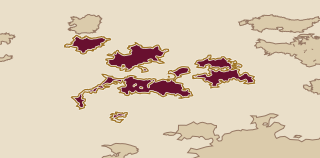
The appellation favours Tempranillo above everything else. Under Ribera del Duero regulations, the grape is the primary red variety and the only one used at Tábula. What varies from bodega to bodega is where within the appellation the grapes come from, and Tábula's answer is seven municipalities: Olivares de Duero, Anguix, Roa, La Horra, Olmedillo, Quintanamanvirgo and Boada de Roa. Each sits at a slightly different altitude and aspect, giving the cellar fruit from contrasting Ribera del Duero microclimates rather than a single uniform address.
In the cellar
Vineyards and cellar
Vineyard work at Tábula follows a fruit-first philosophy. The bodega's own language prioritises the integrity of the grape and the character of the specific territory where each parcel sits, which in practice means harvest timing calibrated to fresh aromatics rather than maximum phenolic ripeness.
Wines to know
The range in view
The range has two levels, both 100 percent Tempranillo, both under the Damana label.
The Damana Roble is the lighter and earlier-drinking of the two. Five months in French and American oak leaves the wine fruit-forward, with the berry character of the Tempranillo grape sitting above a faint vanilla and toast note. It is not a simple wine but it asks for little patience.
A useful way in
A bottle to begin with
Start with the Damana Crianza. It is 100 percent Tempranillo from Ribera del Duero parcels spread across seven municipalities, aged twelve months in predominantly French oak, and it shows exactly what Tábula is aiming at: fresh aromatics, raspberry and plum fruit, soft tannins, a spice note from the licorice and fennel character of the grape and the appellation, and enough body to feel like a proper glass of wine without weight. The oak is present but measured. The finish is clean. It is the wine that sits at the centre of the range and answers the question of what Tábula's multi-parcel approach sounds like in the bottle.