
Why it matters
The producer
Boekenhoutskloof is a Franschhoek Valley wine estate and the most commercially ambitious serious wine operation in South Africa. The farm, established in 1776 and restored from near-dereliction in 1993, produced its first commercial vintage three years later, shipping 6,000 bottles. Thirty years on, the group produces over six million bottles combined across all its labels.
Marc Kent is the reason. He joined as the estate's first winemaker in 1994, fresh from Elsenburg Agricultural College, and never left. Today he holds the title Managing Partner and Technical Director and signs off on every blend the house produces, from the cellar's most concentrated single-vineyard Syrah down to the entry-tier Wolftrap. That continuity across three decades and six price points is the thread that holds the portfolio together.
Place and vineyards
Where the wines begin
The home estate sits in the Franschhoek Valley, a long, narrow mountain basin roughly 75 kilometres east of Cape Town, with granite and sandstone slopes rising on three sides. Franschhoek carries its own Wine of Origin appellation, and the estate Syrah and Semillon are labelled accordingly.
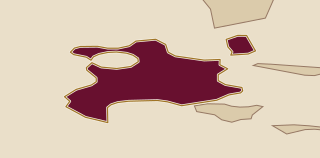
Porseleinberg is a different address. It is a single farm in the Swartland, the inland wheat-and-wine district north of Cape Town that became the centre of South Africa's new-wave natural and minimal-intervention movement in the 2000s and 2010s. The Swartland appellation appears on the Porseleinberg label, separating it physically and legally from the Franschhoek estate wines.
In the cellar
Vineyards and cellar
At Porseleinberg, whole-bunch fermentation takes place in concrete tanks with a submerged cap, a method that retains stem tannin and adds a savouriness and aromatic lift that crushed-berry fermentation alone does not produce. After fermentation, the wine matures for twelve months in large 2,500-litre oak foudres (95%) with a small portion held in concrete eggs (5%). No new wood is used. The foudres are large enough that oak contribution is minimal; what they provide is slow, gentle micro-oxygenation without flavour imprint.
Across the premium range, the cellar does not acidify. This is a deliberate choice in a warm climate where many Cape producers add tartaric acid to lift wines that would otherwise feel heavy. Cold barrel storage and lees ageing preserve freshness without chemical adjustment.
Wines to know
The range in view
The range runs across five distinct levels.
Porseleinberg Syrah is 100% Syrah from the single Swartland farm. It is the cellar's most concentrated and age-worthy bottle, with a nose of blackberries, violets, dried herbs, smoked meat, and graphite, and a palate that carries firm tannin and a long, mineral finish. The combination of whole-bunch fermentation and large-foudre ageing without new oak produces a Syrah that stays dark and compact rather than opening into easy fruit.
A useful way in
A bottle to begin with
Start with The Chocolate Block. It is the wine that shows what Boekenhoutskloof does with Syrah as a structural backbone, how Grenache adds body and warmth, how a small percentage of Viognier lifts the perfume without announcing itself, and how the blend holds together at volume without thinning. The texture is plush and the fruit is generous: this is a warm-climate Rhone blend made with enough acidity to stay lively. It is widely available, priced in the mid-premium range, and gives a clear picture of the cellar's approach before moving to the more demanding and age-dependent Porseleinberg.