
Why it matters
The producer
Bonterra Vineyards farms certified organic fruit in Mendocino County, a long coastal California county where Pacific fog holds temperatures down and extends the growing season well past what the Napa Valley norm allows. The estate operates formally as Fetzer Vineyards DBA Bonterra Organic Estates, a name that records the transition from a family-estate past to an explicitly sustainability-led present. Since 2000, every vineyard in the operation has held USDA organic certification. In October 2021, Bonterra became the first organic winery anywhere in the world to receive climate neutral certification, a distinction that required a full third-party audit of vineyards, winery, and supply chain.
Sheep graze between the vine rows. The practice is not decorative: it eliminates tractor passes for weed management, which cuts diesel consumption and compaction across the entire farmed area. Bonterra operates at commercial scale, making Chardonnay and Zinfandel as the two central wines of the range, with a rosé and a sub-line called The Econic alongside.
Place and vineyards
Where the wines begin
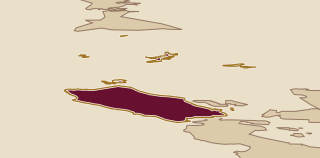
Mendocino County sits roughly 160 kilometres north of San Francisco, running from the Pacific coast inland through a series of valleys and ridges. Hopland, where Bonterra is based, lies in the Redwood Valley and Cole Ranch area of inland Mendocino, where afternoons are warm enough to ripen Zinfandel fully but mornings cool quickly. The county as a whole has a longer, slower ripening season than Napa or Sonoma, and the elevation shifts between coastal and inland zones mean grapes retain their natural acidity without intervention. For Chardonnay, that translates to fruit that can be picked with freshness intact. For Zinfandel, the warmth gives ripe berry character while the night temperatures keep the wine from reading as overripe or flat.
Mendocino has a farming culture that predates the current organic movement by decades. The county has long attracted producers committed to land stewardship, and Bonterra's certifications sit inside that regional character rather than against it.
In the cellar
Vineyards and cellar
Bonterra farms organically across Mendocino County vineyards. No synthetic herbicides, pesticides, or fertilisers are used, and the sheep grazing program handles weed management mechanically through animal labour rather than machinery. The regenerative certification earned in 2021 goes beyond organic requirements and addresses soil health, biodiversity, and carbon sequestration as active farming goals rather than passive side effects.
In the cellar, the Zinfandel spends twelve months in French oak barrels before bottling. French oak at that duration adds spice and a soft vanilla frame to Zinfandel's naturally jammy berry character without loading the wine with obvious wood tannin. Petite Sirah is blended in to deepen colour and add grip and perfume. The Chardonnay receives oak treatment that shows on the palate as a creamy texture and subtle toast on the finish, and the wine's acidity is managed to stay present enough to carry the wine forward over four additional years of cellaring.
Wines to know
The range in view
The two anchors of the range are Chardonnay and Zinfandel, both from certified organic Mendocino County fruit and both made for accessible drinking with enough cellar life for short-term aging.
The Bonterra Chardonnay is white, with a nose that moves between fresh fruit and baked aromatics: pear, green apple, and citrus alongside jasmine, candied ginger, and a buttered popcorn note that signals some oak contact. On the palate it is round and creamy with uplifted acidity and a finish that carries subtle toast. It will drink well from release and continue to develop for up to four years.
A useful way in
A bottle to begin with
Start with the Bonterra Zinfandel. It carries the producer's core decisions in one bottle: certified organic Mendocino fruit, twelve months in French oak, and a deliberate Petite Sirah addition that shows how the winemaking team works to build complexity rather than rely on the grape alone. The wine is ripe and warm, with dark berry fruit, spiced oak, and a finish that has more substance than a simple California Zinfandel typically offers at this price. It is also the bottle where the farming philosophy is most legible: organic viticulture at this scale producing a red wine that tastes like the county it comes from.