
Why it matters
The producer
The vineyards at Boschendal cover 2.54 square kilometres between the Groot Drakenstein and Simonsberg mountains, making it one of the larger estate footprints in the Western Cape. The farm's title deeds are dated 1685, and the flagship Chardonnay carries that year on the label, tying every bottle to the original Huguenot land grant.
Substantial plantings of Chardonnay and Sauvignon Blanc anchor the white wine range, with Cabernet Sauvignon, Merlot, and Shiraz among the red varieties. The 1685 Chardonnay departs from a purely estate model: fruit comes from Stellenbosch, the Elgin Valley, and the home farm, blended for a complexity no single site would provide.
Place and vineyards
Where the wines begin
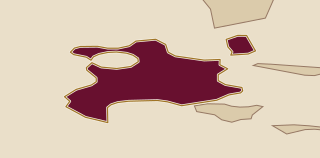
Boschendal sits in the Franschhoek valley corridor, where the Groot Drakenstein and Simonsberg mountain ranges close in on either side. The farm's vineyards lie within the Coastal Region, a broad Western Cape appellation that covers several distinct growing climates.
The three terroirs behind the 1685 Chardonnay tell the site story more precisely than any single coordinate. Stellenbosch contributes fruit from well-drained soils at the heart of South African red wine country. The Elgin Valley, set at higher altitude with cooler temperatures, gives acidity and freshness. Boschendal's own mountain-flanked land adds the estate's historic character. The blend across these three areas is the estate's way of building depth that the home farm alone cannot achieve.
In the cellar
Vineyards and cellar
Boschendal's home vineyards cover 2.54 square kilometres between the Groot Drakenstein and Simonsberg mountains. Chardonnay and Sauvignon Blanc lead the white plantings; Cabernet Sauvignon, Merlot, and Shiraz are among the red varieties.
For the 1685 Chardonnay, fruit from Stellenbosch, the Elgin Valley, and the estate is fermented in two ways: 70% goes into oak barrels, and 30% into stainless steel tanks. Both portions rest on their lees. The barrel-fermented portion then spends ten months in barrel, with 12% of that volume in first-fill oak and the remainder in second, third, and fourth-fill barrels. Monthly lees stirring, known as bâtonnage, adds creaminess to the mid-palate during this ageing period. The stainless steel portion preserves the wine's aromatic freshness, and the two components are blended before bottling.
Wines to know
The range in view
The estate range is built around the 1685 label, which carries the founding year and positions each wine within Boschendal's long history. The 1685 Chardonnay is the flagship white, a multi-terroir blend from Stellenbosch, Elgin, and the home farm that is partly oak-fermented and partly tank-fermented, with both fractions aged on lees. A Brut sparkling wine made from Chardonnay and Pinot Noir also carries the Boschendal name. Beyond the 1685 tier, the estate makes wines from Sauvignon Blanc, Cabernet Sauvignon, Merlot, and Shiraz, covering the main varieties grown across the Western Cape.
The 1685 Chardonnay sits at the top of the white range. Its three-terroir approach means the wine draws on both the warmer, fruit-forward character of Stellenbosch and the cooler, more acidic profile of the Elgin Valley, held together by the home farm's character and the lees-ageing texture from the cellar.
A useful way in
A bottle to begin with
The 1685 Chardonnay is the bottle that opens up how Boschendal works. It is a Western Cape Chardonnay built across three sites rather than from a single estate block, with fruit from Stellenbosch, the Elgin Valley, and the home farm blended to give the wine a range of texture and acidity that no single location would supply. The oak-fermented portion contributes body and lees creaminess; the tank-fermented fraction keeps green apple and citrus vivid on the nose. The result sits at 13.5% alcohol with 4 grams per litre of residual sugar, dry and structured, with enough weight to sit alongside food and enough freshness to hold the aromatics through the finish.