
Why it matters
The producer
The Bottega family claims vine-growing roots in Refrontolo going back to 1635, when Andrea Bottega cultivated parcels near the rocky mill of Molinetto della Croda in the Treviso hills. The modern company was built three centuries later: Aldo Bottega founded the distillery in 1977 in Pianzano di Godega, and Bottega Gold, the gold-lacquered Prosecco bottle that would become the top-selling sparkling wine in global travel retail, followed decades of incremental commercial expansion. By 2022, that gold bottle had outsold Champagne and Cava in airport duty-free shops worldwide. Bottega is a large-scale commercial producer spanning wine and spirits: 14 million litres a year, 98% Italian-sourced raw materials, and a range that runs from everyday Prosecco to monovariety grappa.
Place and vineyards
Where the wines begin
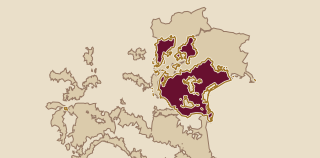
Bottega's Prosecco Superiore DOCG vineyards sit on the hillside territory between Conegliano to the east and Valdobbiadene to the west in Treviso province. This is where appellation law draws its sharpest line. The DOCG designation requires steeper slopes, lower yields, and hand harvesting on hillside parcels, conditions that differ materially from the much broader Prosecco DOC zone spread across nine provinces in northeastern Italy. On DOCG hillsides, the Glera grape has to work harder for ripeness, and the wines that result tend to carry more aromatic lift and sharper acidity than flatter, volume-driven DOC production. The territorial claim on the label, "Prosecco Superiore," is the legal acknowledgement of that hillside distinction.
In the cellar
Vineyards and cellar
Bottega's 60 hillside hectares supply estate fruit for the DOCG range, with the remaining volume sourced from Italian-grown grapes (98% Italian-sourced across the full operation). Glera on DOCG hillside parcels is harvested by hand, a legal requirement of the Superiore appellation that limits mechanisation and applies natural selection pressure during picking. The secondary fermentation for Prosecco Superiore takes place in pressurised tanks rather than bottle, the method known as Charmat or Martinotti, which preserves Glera's fresh pear and white flower aromatics rather than adding the toasty, bready character associated with bottle-fermented sparkling wine. For grappa, Bottega uses pomace distillation with attention to single-variety separation, a practice that keeps the aromatic profile of each grape distinct through the still.
Wines to know
The range in view
The Prosecco Superiore DOCG range is the foundation of the wine side of the business. Bottega Millesimato is the vintage-dated entry expression, bottled at 11% ABV with delicate pear and peach fruit, light mousse, and the clean, low-alcohol freshness; it is the most approachable bottle in the range. Bottega Gold is the premium DOCG Prosecco: same Glera base on hillside parcels, but the wine shows an additional herbaceous complexity, a sage-like green note sitting alongside the fruit, and a finer mousse with slightly more persistent bead. The gold lacquered bottle is a deliberate visual marker rather than a packaging accident, and the wine inside is measurably more concentrated than the entry level. Beyond Prosecco, the range includes still Veneto wines under regional denominations, and a grappa line that spans monovariety and aged expressions. The grappa catalogue remains a serious part of the portfolio alongside the sparkling-wine volume.