
Why it matters
The producer
Botter makes its case on a single method applied to a single southern Italian grape. The company was founded in 1928 by Carlo Botter and his wife Maria in Fossalta di Piave, a small town in the Veneto near Venice, where they sold wine in bulk. Today the operation is run by the third generation and spans two Italian regions, with 23.5 million litres of storage across 452 fermentation tanks. The commercial centre has moved south.
Doppio Passo Primitivo is an IGT Puglia wine produced at Masseria Doppio Passo, a 1,500-hectare estate in Salice Salentino that Botter acquired in 2017. The estate gave the brand its own land base in Puglia for a range that already carried the Doppio Passo name. The name is not marketing shorthand: doppio passo means double step, and it describes exactly how the grapes are grown, harvested, and fermented.
Place and vineyards
Where the wines begin
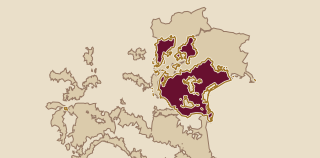
Salice Salentino sits near the southern tip of Puglia on the Salento peninsula, the narrow heel of the Italian boot that pushes into the Adriatic and Ionian seas. The climate is one of the hottest and driest in Italy: long summers, low rainfall, and intense sun that push Primitivo towards high sugar levels, deep colour, and concentrated dark fruit. Wines from this part of Puglia carry weight by default; the winemaking question is what to do with that weight.
Salice Salentino is a DOC appellation, but Botter's Doppio Passo is labelled IGT Puglia, giving flexibility to source across a broader area of the Salento peninsula. The Primitivo Organic draws from three provinces: Lecce, Taranto, and Brindisi, covering most of the southern Puglian plain. Nero d'Avola crosses the water to Riesi in the Caltanissetta province of Sicily, where clay soils give the grape more savour and firmer grip.
In the cellar
Vineyards and cellar
The Doppio Passo method begins in the vineyard with a split harvest. Pickers move through the Primitivo rows twice, with the second pass coming roughly ten days after the first. Before that second pick, a portion of the grapes is left on the vine to partially dry, concentrating the sugars and intensifying the fruit. This technique borrows from the dried-grape winemaking tradition of northern Italy and applies it to a southern grape in a hot climate.
After primary fermentation, the wine undergoes a short second fermentation on the pulp and skins left from the first. This ripasso step draws extra colour, body, and texture from the marc, pushing the wine towards a richer mid-palate without needing extended maceration time. The result sits between a conventional fermented wine and a full dried-grape wine in body and concentration.
Wines to know
The range in view
The Doppio Passo range is built around two southern Italian varieties and two production approaches.
Doppio Passo Primitivo IGT Puglia is the core wine. One hundred percent Primitivo from Salice Salentino, made with the two-stage harvest and ripasso second fermentation. The method adds body and dark fruit depth on top of the grape's natural weight. Ripe black cherry, blackberry, and smooth mid-palate texture. Soft tannins and a fruit-forward finish that sits low in grip.
A useful way in
A bottle to begin with
Start with Doppio Passo Primitivo IGT Puglia. It is 100% Primitivo from Salice Salentino, harvested in two stages and passed back through the fermentation skins for extra body and fruit concentration. Black cherry and blackberry on the nose, a rounded and generous mid-palate, low tannin, and a warm finish. The method is what Botter is built on, and this bottle demonstrates it without distraction. It is the most widely available wine in the range and the clearest expression of what the double-pass harvest and ripasso second fermentation actually produce in the glass.