
Why it matters
The producer
Braida di Giacomo Bologna sits on a hill road in Rocchetta Tanaro, a village of roughly 1,200 people in the sandy uplands of Asti province, Piedmont. Giacomo Bologna founded it in 1961 at a moment when Barbera was not taken seriously as a cellar wine: it filled carafes in Piedmontese trattorias, blended into bulk, and moved out quickly on its sharp, undisciplined acidity. Giacomo looked at the same grape and saw something the trade had written off.
His answer was two decisions made together: harvest later and age in French oak. The late pick let sugars accumulate on the vine while acidity softened, changing the physiological character of the fruit before it ever reached the cellar. The barriques did something no large Slavonian cask in the region was doing: they added tannin, smoothed the mouth feel, and gave the wine a reason to stay in a bottle for years. Neither decision was common in Asti in the early 1980s. Both turned out to be consequential well beyond Rocchetta Tanaro.
Place and vineyards
Where the wines begin
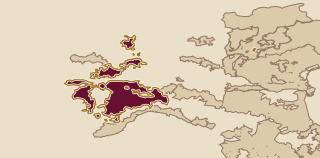
Rocchetta Tanaro is in the Basso Monferrato, the lower rolling hills that lie between the Po plain and the steeper slopes of the Langhe further south. The soils here are lean and sandy, a different register from the clay and limestone that dominates much of Barolo and Barbaresco country. In those sandy soils, Barbera gives wines that are softer and more harmonious than the grape produces on heavier ground: less extracted, more fluid, with acidity that can be managed rather than fought.
The appellation on the estate's top wines is Barbera d'Asti, a DOC covering the Asti and Alessandria provinces, with Superiore as the elevated tier requiring longer ageing and lower yields.
In the cellar
Vineyards and cellar
Braida's parcels sit on hillside positions between 250 and 450 metres, with the most important vineyards named by their individual bricco. Lower yields than the regional norm were central to Giacomo's approach from the first Uccellone harvest: concentrating fewer grapes per vine produced fruit with more depth and less of the dilute, high-acid character that gave Barbera its bulk-wine reputation.
In the cellar, the style varies by wine and vineyard. The flagship wines use French oak barriques, as Giacomo established for the 1982 vintage. Montebruna, a Barbera d'Asti from the estate range, goes into Slavonian oak instead, a larger cask format with less wood influence and a more classically Piedmontese weight. Curej, sourced from the San Bernardo hill, spends 15 days on its skins during maceration before moving to large oak for three months, a shorter contact time that preserves the fresh fruit character of the grape rather than building extended tannin.
Wines to know
The range in view
Barbera is the spine of everything Braida makes. The range moves from a frizzante Barbera through single-vineyard crus to the estate's founding wine.
Bricco dell'Uccellone is a Barbera d'Asti Superiore from a single named hillside in Rocchetta Tanaro. It was the wine that proved the French-oak, late-harvest approach would work with this grape. Yields are low, the wine carries the Superiore designation, and it is the most cellar-demanding bottle in the range.
A useful way in
A bottle to begin with
Bricco dell'Uccellone is the wine to open first. It is the wine Giacomo Bologna built his argument around: a single hillside in Rocchetta Tanaro, Barbera harvested later than the neighbours, 18 months in new French oak for the first vintage in 1982. In the glass it is dark and concentrated, with plum, blackberry and a warm dried-herb edge from the oak ageing. The acidity is present but softened by the fruit weight and the wood, and the tannin gives the wine a cellar arc that Barbera rarely achieves without this kind of intervention.