
Why it matters
The producer
Brookdale Estate sits in the foothills of the Klein Drakenstein mountains on the eastern edge of Paarl, built on land that Tim Rudd, a proprietor from Brookdale in Derbyshire, found overgrown and largely abandoned. The name is literal: he brought it from home and planted it in the Western Cape. His founding decision was not Cabernet Sauvignon or Chenin Blanc in the regional mainstream sense, but a Mediterranean-varietal focus, Syrah, Grenache, Mourvedre, and Chenin Blanc, suited to Paarl's warmth and the altitude cooling the Klein Drakenstein provides.
From the 2025 harvest, the estate is led by Xander Sadie as head winemaker, with Shanice du Preez as assistant. Both are among the most closely watched young names in South African wine, and their joint arrival at Brookdale in the same season is the clearest signal yet of where the estate is heading.
Place and vineyards
Where the wines begin
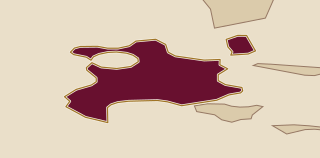
Paarl is one of the Western Cape's largest and oldest wine districts, lying inland from the Cape Peninsula and running north toward Franschhoek. The district is warm and receives reliable sun through the growing season, which pushes Syrah and Grenache toward ripe, fleshy fruit rather than cool-climate spice alone. The Klein Drakenstein range, which forms a granite and shale wall along the eastern edge of the appellation, tempers that warmth at higher elevations. Vineyards in the foothills receive afternoon shadow earlier than valley-floor sites and hold more moisture through the summer months.
For Brookdale, the mountain position matters in the glass. Paarl Syrah without altitude tends to be full-bodied and broad; the Klein Drakenstein site keeps acidity present and gives the fruit a tangy, mouthwatering lift that stops the wines from becoming heavy.
In the cellar
Vineyards and cellar
The Mason Road Syrah 2022 gives the most detailed picture of how Brookdale works in the cellar at this stage. A portion of the Syrah grapes were fermented whole-bunch, without destemming, which adds a fresh, peppery lift and a degree of tannin grip that purely destemmed Syrah in warm climates can lack. After fermentation, the wine spent eight months in French oak, with 40 percent of the barrels used for their third fill. Third-fill barrels contribute almost no new oak flavour; they allow slow, gentle oxygen contact without adding vanilla or toasty wood character to the fruit. Foudre barrels, the large-format casks used alongside the smaller barrels, extend that neutral ageing environment further.
The result in the glass is a Syrah that reads as fruit-forward and textural without carrying obvious oak. The whole-bunch element shows up as a spicy, meaty lift on the nose rather than as heavy tannin on the palate.
Wines to know
The range in view
Mason Road is the entry label, drawn from young vines and priced for regular drinking. The range includes Mason Road Chenin Blanc, Mason Road Syrah, and Mason Road GSM, a Grenache, Syrah, and Mourvedre blend. The Syrah is dense and spice-led, with tangy acidity. The GSM shows a different character from the Syrah: the nose is lifted and aromatic, with blackberries, licorice, and fennel seeds, and the palate is juicy and direct, with spicy sour cherry and a modest cocoa note on the finish. Where the Syrah is richer and meatier, the GSM runs lighter and fresher.
The prestige tier includes Bradbourne, Old Vine Chenin Blanc, and Sixteen Field Blend. The Old Vine Chenin Blanc draws on a parcel planted in 1985, giving it vine age that very few Paarl estates can match for this grape.
A useful way in
A bottle to begin with
Mason Road Syrah 2022. It is a Paarl Syrah made with a portion of whole-bunch fermented fruit, aged for eight months in older French oak and foudre barrels, and scored 93 points by Greg Sherwood MW. The nose is immediately distinctive: sweet cherry kirsch and coriander lead, with peppercorn, cured meat, and dark cassis following. The palate is fleshy and dense, with tangy acidity keeping everything in motion and a finish that is long and spiced. For a wine at the Mason Road price point, the textural breadth is unusual. It also shows what the Klein Drakenstein site and the whole-bunch cellar decision do together: warmth in the fruit, spice from whole-bunch fermentation.