
Why it matters
The producer
The Gil family have been making wine in Jumilla, the appellation in Murcia in southeastern Spain, since the early twentieth century. For most of that time they were one family among many farming the plateau's stony ground, selling grapes and bulk wine through the local cooperative system. That changed in 2003 when Miguel Gil, great-grandson of the company's founder, completed a new bodega in time for the harvest, turning the family into an estate producer with the capacity to vinify and bottle at scale.
The operation is now part of Viñas Familia Gil, a group of small wineries assembled across Spain since 2002. Within that group, Bodegas Juan Gil is the Jumilla anchor: over 750 hectares, mainly old bush vines grown without irrigation, with the bodega maintaining its own nursery of indigenous Monastrell clones rather than buying in plant material from outside. The most singular project in the portfolio is Bruto, a pure Monastrell wine that began not in a board meeting but in a conversation between a winemaker, an actor, and a painter.
Place and vineyards
Where the wines begin
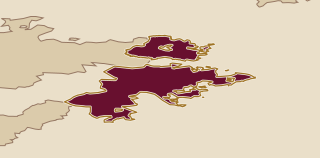
Jumilla sits on a high inland plateau in Murcia, separated from the Mediterranean coast by ranges of limestone and pine. Summers are long and dry, winters drop hard, and the continental temperature swings between those extremes are more severe than on Spain's Atlantic or Mediterranean fringes. The plateau soils are predominantly poor and stony, with thin topsoil over limestone bedrock, and they drain fast. Rainfall is scarce enough that unirrigated vines here survive by sending roots deep rather than wide.
That combination of heat, drought and poor ground produces Monastrell with a particular character: dark-fruited, rich in body and tannin, concentrated rather than dilute. Jumilla received Denominación de Origen status in 1966 and built its reputation on this grape, which accounts for the majority of the appellation's vineyard area. The appellation rules allow irrigation under certain conditions, but old bush vines farmed without water express a different quality of fruit: lower yields, smaller berries, denser colour and flavour.
In the cellar
Vineyards and cellar
The bush vine training system used across the estate keeps yields low without irrigation. Bush vines, known in Spanish as vaso or en vaso, train the vine into a free-standing, goblet shape with no wire support. Each plant draws on deep soil reserves rather than surface moisture, which drives concentration in the fruit rather than volume. The indigenous nursery clones are selected from within the estate's own vine population: plant material chosen for performance on these specific soils rather than for generic adaptability.
Wines to know
The range in view
The range runs across three distinct formats, each built on Monastrell but with a different expression.
Pedrera is the unoaked entry: one grape, no wood, the direct character of Jumilla's stony fruit. The descriptors from the source are rich and concentrated, with the intensity that old bush vines on poor soils produce when the yield is controlled. It delivers Monastrell unmediated by barrel contact.
A useful way in
A bottle to begin with
Bruto is the bottle that shows what the Gil family and this place are capable of when everything is directed at one wine. It is pure Monastrell, aged twenty months in French oak, built from the estate's old unirrigated bush vines. The name and the Ángel Haro label signal that this is not a commercial category wine; it is a deliberate choice to take the grape as seriously as possible without reaching for prestige language to justify it. In the glass it is dark-fruited, full-bodied and tannic, with the oak well-absorbed into the fruit after the long barrel contact.