
Why it matters
The producer
Dalva is a Port shipper whose lodges sit in Vila Nova de Gaia, the narrow strip of cellars across the Douro River from Porto where most of the great Port houses have aged their wines for centuries. The company behind the Dalva label, C da Silva (Vinhos) SA, traces its founding to 1862, when Corrêa Ribeiro e Filhos was established with the explicit aim of making distinctive wines in the region. The house changed hands once, in 1933, through inheritance rather than commerce, and the name changed with the ownership. Everything else stayed.
Ana Doro Beiroco has been the winemaker at Dalva for twenty-five years. That kind of tenure is rare in a trade where house styles can quietly drift with each appointment. She oversees the colheita programme, the dry white Port, and the full range of tawny and ruby expressions. The colheita archive is the editorial centrepiece: Dalva keeps one of the widest selections of single-harvest tawny wines among all Douro shippers, with stocks spanning multiple decades.
Place and vineyards
Where the wines begin
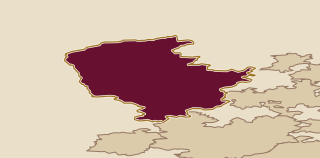
Port production runs across two geographies, and the distinction matters to the label and the glass. Grapes grow on the steep schist terraces of the upper Douro Valley, where thin rocky soils, extreme heat in summer, and cold winters push the vines to concentrate sugar and extract. Dalva draws on Quinta dos Avidagos, its own estate in the Douro, supplemented by grapes from across the demarcated region.
Quinta dos Avidagos is planted on the schist that defines Douro viticulture. Schist fractures vertically, letting vine roots follow moisture deep into the hillside rather than spreading laterally through topsoil. The five varieties Dalva uses, Tinta Barroca, Tinta Cão, Touriga Nacional, Tinta Roriz, and Touriga Francesa, each bring something specific: Touriga Nacional adds dark fruit and tannin backbone, Tinta Barroca softens the blend with lower acidity and rounded texture, and Tinta Cão and Touriga Francesa add aromatic lift and age-worthiness.
In the cellar
Vineyards and cellar
At Quinta dos Avidagos, the five traditional Douro varieties are grown on schist terraces in the valley. Supplementary grapes come from within the demarcated region, giving the winemaking team access to fruit across multiple sub-zones and altitude bands.
In the cellar, Port production follows the traditional method. Grapes are crushed and fermentation begins, with the winemaker monitoring sugar levels closely. When roughly half the natural sugar has converted to alcohol, grape spirit is added, stopping fermentation and fixing residual sweetness in the wine. The fortified wine is then transferred to oak barrels at the Vila Nova de Gaia lodge.
Wines to know
The range in view
Colheita Port sits at the centre of the Dalva range. A colheita is a single-harvest tawny Port, aged in small oak casks for a minimum of seven years before release, though Dalva's stocks extend far beyond that minimum. The wine on the label carries one harvest year and one bottling date, and the amber colour and oxidative character in the glass reflect the total time spent in wood. Dalva maintains one of the widest colheita selections among Douro shippers, with releases spanning multiple decades of back-vintages, offering a horizontal archive of how the same method reads across different growing years.
Tawny Port, the blended non-vintage expression, draws on the same traditional varieties aged in oak, with the winemaker blending across years to achieve a consistent style. The character is nutty and amber, with dried apricot, walnut, and orange peel from extended oxidative ageing, and a finish that is drier and less fruit-forward than ruby styles.