
Why it matters
The producer
Ca' de Lion is a sparkling wine house in Canelli, a town in the Asti province of Piedmont that sits at the heart of Italy's sparkling wine belt. The house was founded in 1871 by Luigi Ghione, who chose a name that reached back more than two centuries to a family ancestor, Leone Ghione, recorded in 1655. The name Ca' de Lion translates as House of the Lion, and Luigi built the estate under that ancestral name rather than his own.
Five generations of the Ghione family have worked the house since. The focus has remained on sparkling wine, with Pinot Nero and Chardonnay drawn from hillside parcels across the Langhe and Monferrato zones. Two bottles carry the range: the Galaverna Spumante Brut, a single-grape Charmat-method wine from Pinot Nero, and the Alta Langa Millesimato Brut, a vintage-dated classic-method blend made under the Alta Langa DOCG.
Place and vineyards
Where the wines begin
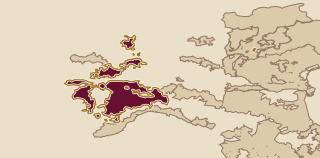
Canelli sits in the Asti province of Piedmont, surrounded by the Langhe and Monferrato hills. These two zones share the same geological origins: hillside soils that are friable, free of rock, and soft underfoot. Ca' de Lion draws from parcels spread across 52 villages in the Asti, Alessandria, and Cuneo provinces, a wide sourcing area that spans much of the vine-growing land between the Langhe escarpments and the Po plain.
The Alta Langa DOCG, which covers the higher-elevation vineyards south of Alba, governs the Millesimato Brut. At altitude, cooler temperatures slow ripening and preserve the acid line that classic-method sparkling wine depends on. The Galaverna, made under the broader Piedmont denomination, comes from Pinot Nero grown on those same friable hillsides at lower elevation, where the fruit ripens to a richer, more immediately expressive character.
In the cellar
Vineyards and cellar
The Galaverna Spumante Brut is made by the Martinotti method, known internationally as the Charmat method. Secondary fermentation takes place in sealed pressurized tanks rather than in the bottle, which preserves fresh fruit aromatics and produces fine, persistent bubbles without extended yeast contact. It is a wine with immediate freshness: red berry, red apple, and grapefruit on the nose, and a dry palate that stays lively rather than developing bready complexity.
The Alta Langa Millesimato Brut follows the classic method, with secondary fermentation and ageing on the lees inside the bottle. The Alta Langa DOCG requires a minimum of 30 months on the lees before disgorgement. Ca' de Lion's specific protocol is not published, but the DOCG floor ensures that the wine develops autolytic character, finer bubbles, and greater depth before release. The 70/30 blend of Pinot Noir and Chardonnay gives the wine a base of red fruit from the Pinot and structural acidity from the Chardonnay.
Wines to know
The range in view
Ca' de Lion produces two sparkling wines, both brut, both made from Piedmontese Pinot Nero with Chardonnay joining in the Alta Langa blend.
The Galaverna Spumante Brut is 100% Pinot Nero, made by the Charmat method, with 0.9 g per 100ml of residual sugar. It is the fruit-forward, early-drinking wine in the range: aromatic and accessible, with red berry and grapefruit on the nose and a palate that moves through red apple, toasted bread, a hint of chocolate, hyacinth, blackcurrant, and winter apple before a clean, dry finish. The bubbles are fine and the effervescence lively.
A useful way in
A bottle to begin with
Start with the Galaverna Spumante Brut. It is 100% Pinot Nero, made by the Charmat method in the Piedmontese tradition that values freshness and immediate fruit over complexity. The residual sugar is 0.9 g per 100ml, dry in every practical sense. On the nose it offers red berry and grapefruit; in the mouth red apple, a suggestion of toasted bread, blackcurrant, and winter apple. The bubbles are lively and the acidity keeps the wine from feeling heavy. It is built for a cold evening and does not need food to work, though it will hold its own against salumi or a light antipasto.