
Why it matters
The producer
Angelo Gaja had spent thirty years making Piedmont's most argued red wines before he drove south to the Tuscan coast. In 1994, Bolgheri was not yet a name that appeared on serious bottle lists. Sassicaia had proved the appellation could produce world-class wine, but the region had not yet drawn the ambitions of producers outside Tuscany. Gaja looked at the clayey-calcareous soils at the foot of the Metalliferous Hills, at the maritime climate, at the Bordeaux varieties already planted nearby, and decided this was somewhere worth spending years acquiring.
The acquisition took long enough that the estate's name says so. Ca' Marcanda is Piedmontese dialect for "the House of Endless Negotiations." Planting began in 1996, in the Bolgheri DOC, in the commune of Castagneto Carducci on the Livorno coast. The winery, when it was finally built, went two-thirds underground.
Place and vineyards
Where the wines begin
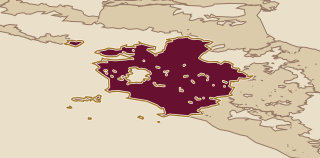
Bolgheri sits on the Tuscan coast in the Livorno province, south of Livorno city and west of the Metalliferous Hills. The climate is Mediterranean in a direct sense: summer heat is dry and long, and the Tyrrhenian Sea, a few kilometres to the west, moderates temperature through the night and into harvest. Bolgheri rarely has the heat stress that affects more inland Tuscan appellations, and the coastal wind keeps humidity low enough to farm without aggressive intervention.
The DOC appellation gives producers legal scope to plant Cabernet Sauvignon, Cabernet Franc, Merlot, and Syrah alongside native Tuscan varieties. At Ca' Marcanda, that permission shapes the entire range: the flagship red is now Cabernet-forward, and the white is built around Vermentino, Viognier, and Fiano rather than Trebbiano or Vernaccia. Place here does not mean Sangiovese country. It means a Tuscan coastal strip where Bordeaux varieties ripen on clay without losing freshness.
In the cellar
Vineyards and cellar
The 80 hectares at Castagneto Carducci are planted predominantly to Cabernet Sauvignon, Cabernet Franc, and the white varieties used in Vistamare. The clayey-calcareous soils across the estate retain moisture through the dry Bolgheri summer, which slows ripening slightly and preserves freshness in the final fruit.
For Camarcanda, the cellar programme runs to 18 months in oak across two vessel sizes: 12 months in barriques, then six months in large 60-hectolitre French oak casks. The move from small to large oak partway through ageing allows the wine to integrate early-stage oak character and then breathe in a lower-extraction environment. Since 2019, 25% whole-bunch fermentation has added a layer of aromatic complexity and softened the tannin extraction that full-destemming would produce.
Wines to know
The range in view
The range has four wines arranged as a clear pyramid.
Promis is the entry-level Toscana IGT red, built for early drinking. Specific grape percentages and cellar detail are not confirmed in current verified sources, so it sits here as the widest tier of the range.