
Why it matters
The producer
Ca' Rugate is a Tessari family estate operating out of Montecchia di Crosara in the province of Verona, with 90 certified organic hectares spread across three appellations: Soave Classico, Valpolicella, and Lessini Durello. The first bottles carrying the Ca' Rugate name were released in 1986, though the Tessaris had grown grapes and sold wine in the area long before that. What the 1986 date marks is a deliberate choice: estate bottling, their name on the label, their name on the line.
Fourth-generation Michele Tessari now leads the estate. His arrival in the early 2000s coincided with a new winery build and a sustained period of vineyard acquisition that added roughly 60 hectares between 2002 and 2021. An operation that had been family-scale became a commercially serious estate with a single-vineyard Amarone cru program and organic certification across all holdings. Since 2013 Ca' Rugate has been a member of the Independent Winegrowers of Soave (F.I.V.I.), placing the estate among growers who bottle from their own vines rather than buying in fruit.
Place and vineyards
Where the wines begin
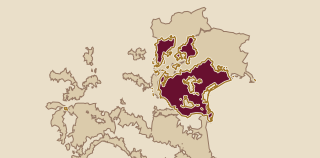
Valpolicella sits in the hills immediately northwest of Verona, a landscape of volcanic basalt, limestone, and clay soils terraced across steep slopes. Soave Classico lies to the east of the city, where volcanic basalt and chalk underlie the vineyards on the hills around the village of Soave. Ca' Rugate works both zones from its base at Montecchia di Crosara, a village at the eastern edge of Valpolicella where the terrain begins to flatten toward the plains.
In Valpolicella, altitude and ventilation shape the grape-drying that produces Ripasso and Amarone. The Punta 470 parcel, Ca' Rugate's single-vineyard Amarone cru, sits at 410 to 440 metres above sea level on terraced slopes, where cooler air and lower humidity during the drying season reduce the risk of unwanted mould and concentrate flavour more slowly. The label on that bottle traces directly to this parcel's position on the hillside.
In the cellar
Vineyards and cellar
All 90 hectares are farmed under certified organic viticulture. In the Valpolicella zone, the key cellar decision is how long the grapes are dried before fermentation. For the Amarone, harvested Corvina, Corvinone, and Rondinella spend four to five months in well-ventilated, humidity-controlled rooms. The slow water loss concentrates sugars, deepens colour, and builds the fruit intensity that defines the style. Fermentation then produces a wine with low residual sugar (3.2 g/L in the Amarone della Valpolicella) despite the concentration, meaning the sweetness reads as ripe fruit rather than obvious residual weight.
The Ripasso method adds a second stage. After Amarone fermentation, the dried grape pomace is used to referment a batch of Valpolicella wine, transferring colour, tannin, and body from the pomace into the lighter base wine. Campo Bastiglia is built this way: deeper than a straight Valpolicella, lighter than Amarone, shaped by both the fresh grape and what the drying process left behind.
Wines to know
The range in view
Ca' Rugate's red range builds on a single grape formula: 45% Corvina, 40% Corvinone, 15% Rondinella. The same blend runs from Rio Albo at the entry tier to the Amarone at the top. The transformation between levels comes from what happens in the cellar and how long the grapes spend in the drying rooms, not from a change in variety or sourcing.
Rio Albo is a fresh Valpolicella: ruby in colour, scented with blackberry and cherry, with soft tannins and a drinking window that opens immediately after release. It is the estate's clearest expression of the grape in its unmodified form.
A useful way in
A bottle to begin with
Campo Bastiglia Valpolicella Ripasso is the bottle that shows how Ca' Rugate's cellar thinking works. It is made from the same Corvina, Corvinone, and Rondinella blend as the rest of the red range, but the Ripasso process, passing the fresh wine over pomace from Amarone's dried-grape fermentation, gives Campo Bastiglia a depth and body that the entry Valpolicella cannot reach and an approachability that Amarone does not offer until it has some years in the cellar. Garnet in colour, the wine delivers concentrated cherry and spice on the nose, with a full-bodied palate and tannins that are firm but never angular.