
Why it matters
The producer
In 1979, Carlos Esteva drove inland from the Catalan coast to a limestone plateau called the Garraf Massif and took over a dilapidated noble farmhouse that had belonged to his grandfather. The house was in ruin. The vineyards were gone. He restored both, and spent the next four decades planting 28 grape varieties across small, unirrigated plots on chalk and clay-limestone soils, farming without irrigation, and making wines that had no clear precedent in Penedès.
The Garraf Massif sits west of Barcelona, within the DO Penedès appellation but on a geological formation distinct from the rest of the region: a large chalky mass, pale and mineral, closer in character to Sherry's albariza than to the river-plain soils that define much of Catalan viticulture. Esteva chose to work from that geology outward, planting grapes suited to chalk and north-facing slopes, and building a range around native Catalan varieties alongside Loire whites and Bordeaux reds.
Place and vineyards
Where the wines begin
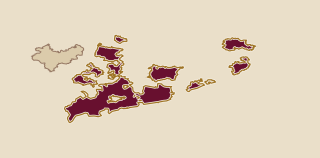
The Garraf Massif is a limestone plateau west of Barcelona. Within DO Penedès, it reads as a distinct geological island: highly chalky, largely unirrigated, with soils pale enough to reflect light back at the vines. The farmhouse at Can Ràfols dels Caus sits near Font de la Canya, a site considered the oldest origin of vineyard cultivation in both Penedès and Catalonia, giving the estate a claim to place that goes beyond appellation paperwork.
The appellation label is DO Penedès, which covers a broad stretch of Catalan wine country, but the Garraf Massif geology and the unirrigated farming place Can Ràfols dels Caus at a distance from the region's commercial centre.
In the cellar
Vineyards and cellar
All 90 hectares of vines are farmed without irrigation. Organic certification applies across the estate, with biodynamic practices on portions of the vineyard. Unirrigated farming on chalk and clay-limestone limits yield and pushes root systems deep into the subsoil, which gives the wines their mineral character and their capacity to carry acidity without feeling thin.
The 28 varieties are cultivated in small, fragmented plots rather than consolidated blocks, which means each variety can be matched to the soil type and aspect where it performs best. Chenin Blanc occupies the chalky white parcels. Xarel·lo from the 1948 vines grows on clay-limestone. The Merlot for Caus Lubis comes from a northwest-facing plot planted in 1984, where the reduced sun exposure slows ripening and gives the wine its savoury, powdery character. Sumoll, the indigenous Catalan red, is handled in the cellar with low extraction to draw out freshness rather than the grip the variety normally produces.
Wines to know
The range in view
The range divides into single-variety whites at the top, blended entry whites below, a single-variety low-extraction red from an indigenous grape, single-variety international reds from named plots, and a blended entry red.
Pairal is 100% Xarel·lo from the oldest vines on the estate, planted in 1948 on clay and limestone. Golden in colour. The nose carries apricot, peach, wild herbs, almond and honey. On the palate, the fruit is ripe and tender, the herbs carry through, mineral hints emerge mid-palate, and a firm acid line holds the finish long. Xarel·lo is native to Catalonia and historically tied to Cava production; here it is treated as a serious still wine from old vines.
A useful way in
A bottle to begin with
Start with Pairal. It is 100% Xarel·lo from the 1948 vines on clay-limestone. It brings together an indigenous Catalan grape, the oldest parcel on the property, unirrigated farming on mineral soils, no oak, no concession to commercial Cava-style production. The wine is golden, aromatic and complex without being heavy: stone fruit, herbs, almond, a firm acid line, mineral hints, and a finish that runs longer than the price suggests it should. It explains what the Garraf Massif produces, what 75-year-old Xarel·lo vines can do, and why Esteva chose to farm this plateau rather than replant with something easier to sell.