
Why it matters
The producer
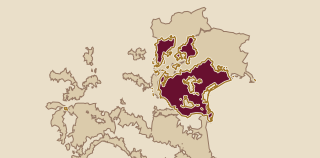
Cantina di Monteforte is a cooperative winery in Monteforte d'Alpone, a village in the eastern Verona wine country of the Veneto, sitting at the heart of Soave territory. Its 450 member growers farm 1,200 hectares of volcanic basaltic land and together produce over four million bottles annually, all centred on Garganega, the thick-skinned white grape that defines Soave DOC.
The cooperative's scale is working scale, not decorative: 450 farming families would find it nearly impossible to maintain cold-chain infrastructure, quality sorting, or market access independently. Monteforte has provided the shared infrastructure that kept small parcels of volcanic ground viable for seven decades. In November 2024, the cooperative's membership voted to incorporate into Collis Veneto Wine Group, Italy's largest cooperative wine organisation, with Collis taking direct production control from the 2025 harvest. The member farming relationships remained intact; what changed was who ran the cellar.
Place and vineyards
Where the wines begin
Monteforte d'Alpone lies in the eastern reaches of the Soave production zone, east of Verona. The broader Soave territory includes both volcanic hillside parcels and flatter alluvial land; Monteforte's growers farm specifically on volcanic basaltic soils, dark and dense, with what the growers describe as reddish and silvery reflections in the turned earth.
Volcanic basalt drains well and retains heat, but it also pushes Garganega toward compact, mineral expression rather than the rounder, fruit-forward character found on calcareous or clay-heavy ground. On this soil, the grape typically produces wines with a citrus and almond axis, firm acidity, and a dry, slightly austere finish rather than soft tropical fruit. The appellation label reads Soave DOC; the volcanic address within that appellation is what separates Monteforte's parcel character from cooperative production on the zone's lowland soils.
In the cellar
Vineyards and cellar
The 1,200 hectares under Monteforte's cooperative umbrella are farmed by 450 member growers working individual family parcels on volcanic basaltic soils. Garganega is the dominant planting throughout, consistent with Soave DOC requirements and with the grape's proven adaptation to this volcanic ground.
Garganega is a late-ripening variety that benefits from the heat retention of dark basaltic soils, which extend the growing season and help the grape reach full phenolic development. The thick skins contribute to wines with enough body and texture to carry the grape's natural acidity without feeling thin. The cooperative's cellar function is to receive, process, and bottle production from across the 1,200 hectares, a task that demands the kind of cold-chain and quality-sorting infrastructure that no individual family farm could justify at this scale.
Wines to know
The range in view
The cooperative's production runs to 140,000 hectoliters annually, over four million bottles, with output spanning bulk and bottled formats at cooperative scale. The bottled range is built on Garganega and targets white DOC wine production in the Soave zone.
Soave DOC requires a minimum of 70 percent Garganega, with Trebbiano di Soave and other permitted varieties filling the remainder. On Monteforte's volcanic parcels, Garganega typically delivers wines that are dry and pale-straw in colour, with firm acidity, citrus and almond character, and a mineral, lightly stony quality on the palate rather than the broader, more neutral style associated with flat-ground Soave. The cooperative's strategic position, confirmed by the Collis merger framing, is at the premium end of white DOC production rather than the entry-level commodity tier.
A useful way in
A bottle to begin with
A Soave DOC white from Cantina di Monteforte is the correct starting point. It is Garganega on volcanic basaltic ground, dry, pale, and mineral-edged, with lemon, bitter almond, and a firm acid line that keeps the finish clean and direct. It is not a rich or oak-influenced wine. It is a wine of the soil rather than the cellar, and the basalt speaks clearly: tighter, more austere, and more defined than the broader category of cooperative Soave would suggest. Open it with white fish, fried seafood, or young cheeses, and the acidity does its best work.