
Why it matters
The producer
Cantina Di Ruscio is a family winery in Campofilone, a hill town in southern Marche where the Aso Valley runs toward the Adriatic. Dante Di Ruscio and his wife Gina pressed their first harvest there in 1953, working with the indigenous grapes of the valley: Passerina above all, alongside Pecorino, Trebbiano, Sangiovese, and Montepulciano. Seventy years on, the winery is in its third generation, and Passerina remains the defining grape, appearing in still, lees-aged, and sparkling forms.
Mario, the second generation, pushed the winery beyond local trade. A third generation followed with formal enological training and updated cellar methods. The range today is clean and fruit-forward, built around the Falerio DOC appellation and the broader Marche IGT designation, with sparkling wines sitting alongside the still bottles.
Place and vineyards
Where the wines begin
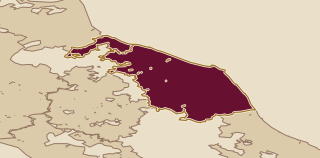
Campofilone sits in the Fermano district of southern Marche, on the low hills between the Aso and Tenna river valleys, roughly forty kilometres south of Ancona. The terrain is hilly and clay-influenced, with Mediterranean breezes from the nearby Adriatic moderating the growing season. This coastal exposure, combined with adequate diurnal range in the hills, keeps acidity alive in the whites even at full ripeness.
Falerio DOC is the local white appellation covering the Piceno hills of southern Marche. It specifies a blend of indigenous varieties: Trebbiano as the majority grape, with Passerina and Pecorino filling supporting roles. The appellation produces dry whites aimed at early drinking, and Di Ruscio's version follows that brief. Marche IGT is the broader designation the winery uses for single-variety bottlings that sit outside the blend requirements of Falerio.
In the cellar
Vineyards and cellar
The still Passerina Marche IGT is made with soft pressing to avoid extracting bitter compounds from the skins, followed by clarification through flotation rather than heavy fining. Fermentation runs in stainless steel at 13 to 14 degrees Celsius, slow and cool, which preserves the aromatic lift in the grape: yellow fruit, a floral note, and the citrus brightness that defines Passerina at its clearest. After fermentation, the wine rests on its lees in steel for three months before bottling. Lees contact at this scale adds texture and a slight breadth to the mid-palate without obscuring the variety's naturally high acidity.
La Musa, a second Passerina bottling, goes through low-temperature fermentation and shows golden reflections alongside the straw yellow base, suggesting a slightly riper pick or a longer pre-bottling rest.
Wines to know
The range in view
Passerina Marche IGT is the plainest expression in the range: 100% Passerina, stainless steel throughout, three months on lees. Straw yellow with greenish light in the glass. Aromas of yellow fruit, apple, and citrus. The palate is mineral and bright, with high acidity and a clean, short finish. Alcohol sits at 12% or just above.
La Musa is the elevated Passerina bottling. The colour carries golden reflections, the aroma moves toward tropical fruit and white flowers, and the palate is described as sapid and full with persistent freshness. It is a longer, richer version of the same grape.
A useful way in
A bottle to begin with
Start with the Passerina Marche IGT. It is the grape alone, vinified to show what Passerina does when kept cool and clean: yellow fruit, citrus, mineral acidity, and a three-month lees rest. The 2019 vintage ran minerals, tropical fruit, apple, and citrus with high acidity from start to finish. It is a dry, refreshing white from a native Marche variety that most wine buyers have not had the chance to meet. Once you know what straight Passerina tastes like in the glass, La Musa and the Audace Brut make immediate sense as extensions of the same grape in different registers.