
Why it matters
The producer
Cantina Gaffino sits along the Via Ardeatina south of Rome, on the volcanic slopes above Ardea, a coastal Lazio town that most Italian wine buyers have never searched for a bottle from. Three generations of the Gaffino family have farmed the same 32-hectare property since 1961, and every wine they make comes from fruit grown on those 28 hectares of estate vines. No purchased grapes, no negociant sourcing.
The current leader, Gabriele Gaffino, arrived at the estate from a career in visual communication and design before taking full charge of the family operation. That pivot from image-making to winemaking is visible in the range: two wines, clearly differentiated, each carrying a distinct classification and a specific argument about what the southern Lazio landscape can do.
Place and vineyards
Where the wines begin
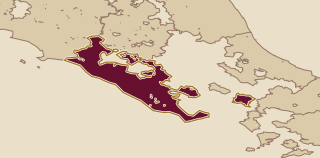
Ardea occupies the southern reach of the Colli Albani volcanic zone, the arc of ancient caldera hills that wraps the southeastern edge of Rome and produces the wines of the Castelli Romani towns: Frascati, Marino, Velletri. Those towns have established DOC appellations for their white wines, built on Malvasia and Trebbiano, the traditional Lazio white varieties. Ardea sits further south, outside that DOC framework.
That position is consequential for the estate's white wine. Because no local DOC covers Viognier grown here, Fojetta is classified as Lazio IGT. The volcanic soils, nutrient-rich from eruptions that shaped the hills over millennia, run beneath both classifications: the mineral baseline is the same whether the bottle reads IGT or DOC.
In the cellar
Vineyards and cellar
All 28 hectares are farmed to organic standards, with ICEA certification in progress. Estate-only sourcing means the family controls every decision from vine to bottle: harvest timing, green harvesting, how aggressively to thin canopy in summer.
In the cellar, the key technical decision is temperature control during Fojetta's fermentation. Viognier is a highly aromatic grape, but its floral and stone-fruit character is volatile: warmer fermentations drive off the aromatics before they stabilize in the wine. The estate ferments at low temperature specifically to hold those aromatics in the bottle rather than lose them to heat during conversion. Fojetta is a white wine that carries its varietal character forward with clarity: flowers and stone fruit on the nose, citrus on the palate, dry and crisp rather than fat.
Wines to know
The range in view
Fojetta, Lazio IGT: One hundred percent Viognier, fermented cold, 13% alcohol. This is a dry white built around the grape's aromatic register: freesia and apricot on the nose, peach and citrus on the palate, clean acid line and minimal tannin. It does not follow the Malvasia tradition of the Castelli Romani; it goes its own direction entirely, planting a Rhone variety on volcanic hillside soil south of Rome and vinifying it to keep the floral lift intact. The IGT classification is the honest label for what this wine actually is.
Roma, Roma DOC: A red blend of Montepulciano, Sangiovese, and Petit Verdot, labelled under the Roma DOC appellation. Dark ruby in the glass. The nose is intense and layered, with a fruity complexity that the fuller Montepulciano brings; the Sangiovese contributes dried cherry and a brighter mid-palate lift; the Petit Verdot deepens the color and adds grip. Full body, round tannins with a velvety texture on the finish, which closes long with toasted notes from oak ageing.
A useful way in
A bottle to begin with
Fojetta is the place to start. It is 100% Viognier grown on volcanic soil south of Rome, fermented cold, and classified as Lazio IGT: a white wine that does not exist anywhere else in quite this form. In the glass it gives freesia and stone fruit on the nose, a dry and lively palate with clean acidity, and a finish that stays crisp rather than flabby. Nothing about it resembles the traditional Lazio white wine canon. Buy Fojetta to understand what this estate is choosing to do on that volcanic hillside, and why the choice is worth the detour from the more familiar Castelli Romani addresses.