
Why it matters
The producer
Cantina Girlan is a cooperative winery in the village of Cornaiano, the German-speaking hamlet the region knows as Girlan, in Alto Adige's Oltradige zone. Around 200 winegrowing families farm in Oltradige and Bassa Atesina. The fruit pools under one cellar and one enologist, Gerhard Kofler, who keeps direct seasonal contact with every grower rather than relying on contract schedules.
The cooperative was founded in 1923 in a 16th-century farmstead that still anchors the site. The cellar was rebuilt entirely in 2010 into a modern winemaking facility, though the cooperative remained unchanged. What drives Girlan's reputation is Pinot Nero: forty hectares dedicated to the grape across the estate's primary crus, with the west-facing Mazon vineyard at the centre of that work. The Trattmann Pinot Nero Riserva won Gambero Rosso Tre Bicchieri for ten consecutive years from 2010 to 2019, a streak that put a cooperative among the names Italian wine critics cite when they discuss the country's most capable Pinot Nero addresses.
Place and vineyards
Where the wines begin
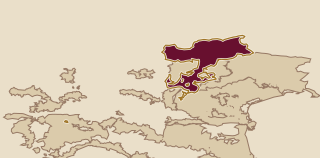
Alto Adige sits at the northern tip of Italy, where the Alps narrow the Adige river valley. Oltradige, the zone on the western bank of the Adige south of Bolzano, is warmer and more sheltered than the valley floor further north, with hillside vineyards that face different directions depending on the bend of the slopes.
Girlan's vineyards on the hillsides above Cornaiano sit between 450 and 550 metres. At that elevation, warm daytime temperatures and sharp overnight cooling give the fruit long hang time without losing acidity. Mazon, the cru most associated with Girlan's Pinot Nero, is west-facing and runs between 360 and 430 metres: a slightly lower, warmer band that suits Pinot Nero's need for thorough ripeness while the altitude and orientation keep the grape from becoming heavy.
In the cellar
Vineyards and cellar
Kofler's seasonal visits to the 200-odd grower families are the cooperative's main quality lever. Each family farms a small parcel, so harvest timing, canopy management, and fruit selection decisions that a larger estate would centralise are instead guided through direct conversation between the enologist and each household. The result across the cooperative is more uniform ripeness and cleaner fruit than the pooled-fruit model might suggest.
For Pinot Nero, the forty dedicated hectares are managed with the intention of producing fruit that is ripe but not overripe, with the elevation and overnight cooling doing much of that work. Mazon parcels are harvested for the Trattmann Riserva separately from fruit destined for Patricia, the mid-tier Pinot Nero.
Wines to know
The range in view
Girlan's range organises into two tiers.
The Classici tier covers Pinot Grigio and Chardonnay at the entry level: mineral, fresh whites grown on altitude hillsides, made to be clean and direct. They carry the acidity and lightness that the elevation provides without additional complexity from oak or extended ageing.
A useful way in
A bottle to begin with
Patricia Pinot Nero is the right first bottle. It is made from Mazon fruit, aged one year in large French oak casks and six months in bottle, and named for Patricia von Elzenbaum, a Mazon winegrower whose parcels contribute to the cuvee. The aromatics are immediate: sweet and sour cherry together, with raspberry lifting the nose. In the mouth the tannin is soft enough to drink now, the acidity keeps the fruit alive through the finish, and the oak sits in the background rather than shaping the flavour. It gives a clear read on what altitude Pinot Nero from Mazon tastes like without requiring the patience or the price that the Trattmann Riserva demands.