
Why it matters
The producer
Cantina Offida works from the hilltop village of Offida in southern Marche, inside a compact DOCG zone that most Italian wine buyers have never needed to know by name. That obscurity is part of what makes it interesting. The Offida DOCG covers only 463 hectares and 72 wineries, a scale closer to a single Barolo commune than to the broad regional appellations that dominate Italian export lists. Within it, Cantina Offida produces roughly 60,000 quintals of grapes each year, working across the zone's indigenous white and red varieties alongside a handful of international grapes.
The winery was born in the 1970s and changed direction sharply in 2010, when a wine group from the wider Piceno territory acquired it and introduced a professional quality team: an oenologist, an agronomist, and a winemaker working in concert. The confirmed commercial range centres on indigenous varieties, with Passerina and Pecorino on the white side and Sangiovese and Rosso Piceno on the red. Castelo, an organic Sangiovese, is the bottle that has reached international retail.
Place and vineyards
Where the wines begin
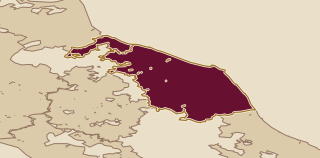
Offida sits in the province of Ascoli Piceno, in the southern arc of Marche where the Apennines begin to press closer to the Adriatic coast. The village itself is on high ground, and the appellation's vineyards follow the hills and valleys below it at elevations that give good diurnal temperature variation during the growing season. Summers are hot and dry, with average temperatures between 21°C and 23°C; winters are mild and wetter, with annual rainfall between 650 and 850 millimetres spread across 80 to 90 rainy days. That dry summer pattern concentrates flavour in the grapes and lets Sangiovese and Pecorino ripen without the dilution that wetter regions can produce.
In the cellar
Vineyards and cellar
Cantina Offida works with both indigenous varieties and international grapes across the Offida zone. On the white side, Passerina and Pecorino are the locally established grapes: Passerina produces lighter, aromatic whites with good acidity and citrus character; Pecorino, which has seen a strong revival across southern Marche over the past two decades, makes fuller-bodied whites with more texture and herbal lift. On the red side, Sangiovese contributes the tannin frame and dark fruit character seen in Castelo, while Rosso Piceno, the zone's DOC red blend based on Montepulciano and Sangiovese, gives a broader, rounder profile.
The organic certification on Castelo Sangiovese confirms that the wine is produced without synthetic pesticides or fertilisers in the vineyard. What is confirmed is that oak is present in Castelo, contributing the vanilla and spice notes alongside the dark fruit.
Wines to know
The range in view
The confirmed range centres on indigenous Marche varieties. Passerina and Pecorino form the white portfolio: both are indigenous to this part of Marche, and both carry appellation weight within the Offida DOCG framework. Pecorino in particular has built a following for its fuller body, herbal and stone fruit character, and capacity to age a few years in bottle without losing freshness. Passerina tends toward lighter aromatics and higher acidity, making it the sharper, more aperitif-styled white of the two.
On the red side, Sangiovese is the grape behind Castelo, the winery's certified organic wine. Rosso Piceno, the DOC blend built on Montepulciano and Sangiovese, broadens the red range with a softer, more immediate profile. The range as a whole is built around accessible Italian reds and whites from a DOCG zone that sits outside the main Tuscany and Piedmont export routes, at price points that reflect the appellation's lower profile relative to its northern neighbours.
A useful way in
A bottle to begin with
Start with Castelo Sangiovese. It is an organic red from Sangiovese grown in the Offida zone, certified vegan, at 13.5% alcohol. In the glass it is dark-fruited and spiced, with cherry, blueberry, black pepper, and oak-derived vanilla layered across a mid-weight frame. The tannins are present but not hard. It drinks well with food and does not require ageing.