
Why it matters
The producer
Cantina Paolini is a cooperative based in Marsala, the port city at Sicily's western tip, drawing grapes from around 1,000 member growers spread across approximately 3,000 hectares of coastal vineyard. The cooperative has been working since its first harvest in 1972, and it has arrived at a house style that runs against the western Sicilian norm: early-picked, sulphur-free, organically certified, and built for acidity and freshness rather than warmth and alcohol.
The scale is large by any measure. But Cantina Paolini harvests every gram of fruit by hand across the entire membership. At 3,000 hectares, machine harvesting is not just common at comparable cooperatives, it is expected. The decision to hand-pick instead costs more and takes longer, and it is deliberate: the house style depends on the gentleness of hand-harvest combined with an early pick date that most producers in the area would consider premature.
Place and vineyards
Where the wines begin
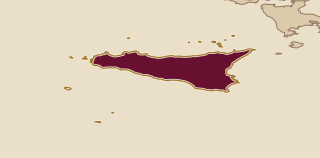
Marsala sits on Sicily's far western coast, facing Tunisia across the Strait of Sicily. The position is maritime in the most literal sense: coastal winds move across the vineyards daily, moderating summer heat and reducing the fungal pressure that forces most conventional producers to spray. For Cantina Paolini, that airflow is what makes organic viticulture viable across 3,000 hectares of cooperatively farmed land.
The coastal exposure also works directly on the grapes. Grillo grown close to the sea retains a saline character in the finished wine, a quality that appears consistently across the Cantina Paolini range. Western Sicily in general produces whites that tip toward richness and alcohol; the combination of maritime winds, early picking, and the salinity of the coastal position pulls the Paolini wines in the opposite direction.
In the cellar
Vineyards and cellar
All fruit is hand-harvested across every member holding. At cooperative scale, hand-picking is an unusual commitment; it adds labour cost and complexity across a membership of roughly 1,000 individual growers, each farming an average of 3 hectares. The practical justification is direct: gentle hand-picking at the moment of early harvest preserves both the physical condition of the fruit and the acidity the house style depends on. Machine harvesters, faster and cheaper, introduce bruising and heat that would undermine what the early pick achieves.
No sulphur is used or added at any stage in the production of the organic wines. This applies from vineyard to bottle. For a cooperative selling into export markets, eliminating sulphur entirely removes a primary tool for controlling oxidation and microbial stability during transit. The wines reach UK and Swedish retailers without it.
Wines to know
The range in view
Three whites anchor the range, each with a different profile and role.
The Grillo Bio 2024 is the most committed expression of the house approach: 100% Grillo, organically certified, no sulphur at any stage, 13.5% ABV. It carries vibrant citrus, grapefruit and lemon at the front, with rounder peach and apricot notes behind, and a distinctive saline minerality that runs through to a clean finish. The acidity is prominent and the freshness is sustained throughout.
A useful way in
A bottle to begin with
The Grillo Bio 2024 is aromatic, fresh, and crisp. It is 100% Grillo, organically certified, hand-harvested, early-picked, and made without sulphur at any stage.