
Why it matters
The producer
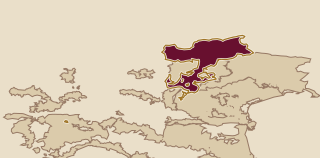
Cantina Produttori Bolzano sits in the city of Bolzano, capital of South Tyrol, the German-speaking alpine province in northeastern Italy, known as Alto Adige in Italian and Südtirol in German. The cooperative was formed in 2001 from the merger of two older cellars, and today 224 member families farm roughly 350 hectares across nine sub-zones of the Alto Adige DOC appellation. That scale places it among the larger producers in a region otherwise defined by small family estates, yet the bottles it makes are anything but industrial.
The cellar at Via San Maurizio was designed to move grapes and wine by gravity alone. Fruit arrives at the building's highest point and descends through each production floor without pumps, a gentler passage through the system that reduces mechanical stress on the grapes. The facility holds CasaClima Wine certification, the regional energy-efficiency standard applied to buildings, which speaks to the same logic: less intervention, lower impact.
Place and vineyards
Where the wines begin
South Tyrol is an appellation built on vertical distance. The valley floor around Bolzano sits at roughly 250 meters, warm enough that Lagrein, a deep, tannic red native to the Gries district, ripens fully on its clay-loam soils. The Santa Magdalena zone, on slopes above the city, is cooler and gives its name to a pale, fragrant red made from Schiava. By the time you reach 800 to 1,000 meters, the growing season is alpine: long days, cold nights, and a narrow harvest window.
That altitude is what makes Pinot Nero work here. The grape needs heat to ripen but cool nights to hold acidity and build the mineral character that separates it from warmer-climate versions. On South Tyrolean sites above 600 meters, Pinot Nero holds that balance naturally. The Alto Adige DOC label covers all of it, from the valley floor to the high parcels, and the range a cooperative like Cantina Bolzano builds reflects that spread.
In the cellar
Vineyards and cellar
Across the cooperative's 350 hectares, altitude does most of the varietal sorting. Lagrein occupies lower-elevation sites where clay soils hold warmth and the grape builds its characteristic dark colour and firm tannin. Schiava sits on the middle-elevation Santa Magdalena slopes, where lighter soils and better drainage give the wine its pale garnet and gentle fruit character. Pinot Nero, Pinot Grigio, and Sauvignon Blanc move to higher sites, where the combination of alpine light and cold nights concentrates flavour without losing freshness.
Wines to know
The range in view
The range covers the cooperative's full altitude spread, from approachable everyday varietal wines on lower-elevation sites to the Riserva tier at the top. Lower parcels supply Schiava and Lagrein: the Schiava is pale and light-bodied with low tannin and easy cherry fruit, a wine for early drinking; the Lagrein carries the deeper colour and firmer grip of the Gries clay-loam, with dark berry fruit and a structured finish that can hold several years in bottle.
Higher-elevation sites produce the whites: Pinot Grigio with alpine freshness and citrus weight, and Sauvignon Blanc that runs more herbal and taut than its Loire counterpart, shaped by the cool nights and mountain light.
A useful way in
A bottle to begin with
The Thalman Pinot Nero Riserva is the bottle to start with. It is 100% Pinot Nero from the Alto Adige DOC, harvested by hand in late September from high-elevation sites, fermented with partial whole-cluster maceration in open wooden vats, and aged twelve months in French barriques. The 2021 vintage shows silky, mineral-driven tannins, red fruit with herbal lift, and a finish with enough acid and grip to carry the wine well past 2030. It is not an especially heavy wine: the alpine growing conditions keep alcohol measured and acidity alive, so the bottle drinks precisely rather than broadly.