
Why it matters
The producer
Cantina Sant'Evasio farms 10 hectares in the Monferrato hills above Nizza Monferrato, a town in Piemonte's Asti province where Barbera has been the dominant grape for generations. The estate is now in its third generation, all fruit is grown around the farmhouse, and the range is built on a single conviction: that Barbera, given the right parcel and enough time in oak and bottle, can hold its own against any red in Piemonte.
The two Barbera-based wines sit at the centre of everything. The Nizza D.O.C.G., from the San Nicolao cru at 230 metres above sea level, spends 18 months in a combination of small and large oak barrels, then a further year in bottle before release. The Barbera d'Asti Superiore, from the same cru at 220 metres, takes a year in large oak and carries eight to ten years of ageing potential. Both are 100% Barbera. Neither is a compromise bottle.
Place and vineyards
Where the wines begin
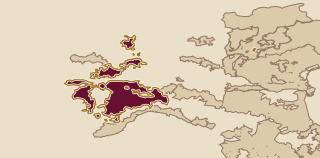
Nizza Monferrato sits in the southern part of the Monferrato hills, east of Alba, in a landscape of rounded clay ridges and marly-calcareous soils. The Barbera grape dominates here, covering more of the Asti province's vineyard area than any other variety. The altitude at Sant'Evasio's San Nicolao parcels, between 220 and 230 metres, gives the fruit a longer growing season than lower valley sites, which translates into better colour concentration, firmer acidity, and a tannin level that Barbera at warmer elevations rarely achieves.
The Arneis vineyard sits higher still, at 280 metres on marly-calcareous ground. Arneis is a white grape native to Piemonte, associated with the Roero hills across the Tanaro river. The Sant'Evasio Rugiada carries the Langhe D.O.C. designation, placing it in the Langhe hills rather than Roero.
In the cellar
Vineyards and cellar
All 10 hectares are farmed by the estate. No grapes are bought in, no négociant wine is made. The Barbera parcels are at the San Nicolao cru, and each wine takes a separate route through the cellar.
For the Barbera d'Asti Superiore, fermentation runs for seven days in steel tanks with the skins present. The wine then moves to large oak barrels for one year. The longer contact with large-format wood gives a softer, more integrated oak note than smaller barrels would, and the 7-day maceration builds enough colour and tannin for the wine to carry eight to ten years in bottle.
Wines to know
The range in view
Three wines, one white and two reds, all estate-grown.
Barbera d'Asti D.O.C.G. Superiore is 100% Barbera from the San Nicolao cru at 220 metres. Seven days of skin fermentation in steel, then one year in large oak. It spends one year in large oak after seven days of fermentation in steel tanks. It is the entry red and the more approachable of the two Barbera bottlings in youth.
A useful way in
A bottle to begin with
Start with the Nizza D.O.C.G. It is 100% Barbera from the San Nicolao cru at 230 metres, fermented for 10 days on the skins, aged 18 months in a combination of small and large oak barrels, and held a further year in bottle before release. In the glass it shows dark cherry and blackcurrant fruit, a firm but integrated oak character, and the kind of clean, driving acidity that Barbera on marly-calcareous hillside soil produces when the site is right. The finish is long and savoury. It has a decade of life in a good vintage. This one bottle explains what altitude, extended maceration, and careful oak selection do to Barbera in the Nizza zone.