
Why it matters
The producer
In 1935, thirty-six vine-growers in the town of Copertino pooled their land and their labour into a single cooperative. Individually, they had no practical route to sell bottled wine. Collectively, they built one. Cupertinum has operated as a cooperative for ninety years.
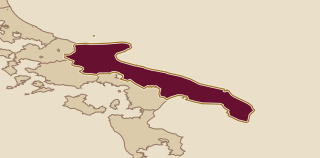
Copertinum sits in the Salento peninsula, the narrow heel of southern Italy between the Ionian and Adriatic coasts, south of Lecce. The appellation it anchors, Copertino DOC, received formal recognition in 1976, relatively late for a region with deep local wine-growing roots. The cooperative farms around 300 hectares of flat, clay-over-limestone vineyard and built its range on a single grape: Negroamaro.
Place and vineyards
Where the wines begin
Copertino DOC covers a flat strip of the Salento interior, lying south of the city of Lecce and distinct from the Salice Salentino DOC to the north and west. The terrain sits at 30 to 60 metres above sea level with little topographic variation. The heat is reliable and prolonged through the growing season; the sea on both flanks keeps air moving and moderates the warmest summer periods.
The soils are clay over hard limestone or tufaceous rock. Clay retains moisture through summer drought, which supports Negroamaro's steady, full ripening without excessive stress. The limestone base contributes to the grape's firm tannin and keeps the wine's acidity from going flat in the heat. Wines labelled Copertino DOC must be predominantly Negroamaro. The Riserva designation requires additional ageing beyond the base DOC standard.
In the cellar
Vineyards and cellar
The vineyards are trained across flat ground with little slope variation. Clay soils hold water through summer, and Negroamaro's thick skins handle sustained heat without losing acidity entirely. The grape's natural tannin load is generous, which means maceration time and temperature matter more than oak ageing as a flavour lever.
For the Copertino DOC wines, maceration on the skins runs seven to eight days at 28 degrees Celsius. The controlled temperature prevents volatile loss and keeps fruit character intact through extraction. After soft pressing, the wine goes into stainless steel for ageing. No barrels. The wine is aged in stainless steel.
Wines to know
The range in view
The range sits on two expressions of Negroamaro.
The Copertino DOC and Copertino Riserva DOC are the core reds. Both use the same maceration and stainless-steel method; the Riserva carries additional ageing and correspondingly more concentration. The colour is ruby red with garnet at the edge. On the nose: blackberry, plum, Mediterranean scrub, ripe fruit, leather. Those aromatics run deep and warm. The palate is full and generous, with almond and blackcurrant tones that settle into the mid-palate and carry through a long finish. The tannin is firm but not hard. No oak means no vanilla or toast to interrupt the grape's own character.
A useful way in
A bottle to begin with
Start with the Copertino Riserva DOC. It is Negroamaro at its most legible in this context: a warm, full, dark southern red with no oak to mask the grape and no extraction excess to harden the tannin. The blackberry and plum on the nose come directly from the grape ripening on clay at Salento's latitude. The almond and blackcurrant on the palate arrive from the same source. The stainless-steel ageing keeps it clean. It is a straightforward wine in the best sense, honest about where it comes from and what Negroamaro does in flat, warm terrain. A grilled lamb chop or aged pecorino next to it is not a coincidence.