
Why it matters
The producer
Cantina Terracanta sits on volcanic land in Ardea, a small town roughly thirty kilometres south of Rome. The agricultural estate behind it, Società Agricola Ceglia, was founded in 1959 when Vincenzo Ceglia left the city for the Roman countryside. The farm grew olives, kiwi, and eventually vines, and by 1986 it had earned the DEMETER mark, the international biodynamic certification that requires independent audit of every farming decision. That date matters: 1986 puts Ceglia's biodynamic commitment well ahead of Italy's natural wine conversation, which largely arrived in the 1990s.
The winery itself, Cantina Terracanta, is the third generation's contribution. Carlo and Lucia formalised it, adding spontaneous fermentation and amphora ageing to an estate that had spent four decades farming without synthetic inputs. The winery produces natural wines with spontaneous fermentation.
Place and vineyards
Where the wines begin
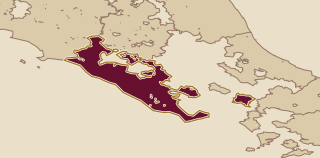
Ardea sits in the Castelli Romani zone of southern Latium, a stretch of volcanic hills and coastal plain that supplied ancient Rome with most of its wine. The town takes its name from the Latin word for heron, and the surrounding landscape is flat near the Tyrrhenian coast before rising toward the Alban Hills. The volcanic activity that shaped this region over millennia left a distinctive soil profile: clay, sand, and silt at the surface, and a subsoil of tuff, the compressed volcanic ash that appears throughout central Italy wherever the earth has been remade by eruption.
In the cellar
Vineyards and cellar
The vineyards grow Trebbiano, Malvasia, Cacchione, and Montepulciano on the volcanic soil of Ardea. Cacchione is a historic white variety native to the Roman countryside, rarely planted outside Latium and largely absent from Italian wine export. Its presence on the estate reflects a broader commitment to local agricultural material rather than internationally recognised grapes.
In the cellar, spontaneous fermentation means no commercial yeast is added at any point. Ambient yeasts on the grape skins and in the cellar environment drive fermentation on their own timeline, which tends to run slower and produce more aromatic complexity than inoculated fermentations but also introduces variability. Whole-bunch maceration for ten days on the white blend means the skins, seeds, and stems remain in contact with the fermenting juice, extracting phenolics, texture, and aromatic compounds before pressing. After fermentation, the wine moves to amphora, the ancient clay vessel that allows slow, micro-oxidative ageing without imparting flavour. Nothing is added to clarify or filter the wine before it is packaged.
Wines to know
The range in view
The range is built around the Sfuso d'Anfora, a white blend of seventy percent Trebbiano and thirty percent Malvasia. Trebbiano is the workhorse white grape of central Italy, high-yielding and naturally high in acidity; Malvasia brings aromatic lift and a softer, more textural quality. Together, macerated for ten days whole-bunch, they produce a wine that sits between a conventional Italian white and an orange wine: deeper in colour than a filtered Trebbiano, more phenolic on the palate, with the saline mineral character of the tuff subsoil running through the finish.
The wine is unfiltered and unclarified. Particles remain in suspension. The colour varies with the vintage and shifts further in the bottle over time. The bag-in-box format, three litres, is not a compromise: it protects an unfiltered wine from oxidation more effectively than a cork over repeated pours, and it suits daily drinking in a way that a 750ml bottle, once opened, cannot sustain without loss of quality.