
Why it matters
The producer
Arnaldo Rivera was an elementary school teacher, not a winemaker, when he walked into the hall of the Town Hall of Grinzane Cavour on 8 December 1958 and signed a deed of incorporation. The problem he was solving was not agricultural. It was economic: Alba brokers had long set grape prices that left Langhe growers with almost no leverage. Rivera's answer was a cooperative, democratically governed, with profits distributed in proportion to each member's involvement. Twenty-two growers signed with him.
Sixty-eight years later, Cantina Terre del Barolo is headquartered in Castiglione Falletto, one of the eleven villages inside the Barolo DOCG zone, and its 300 member growers farm roughly 600 hectares spread across all eleven of those communes. The range sells under both the Cantina Terre del Barolo name and the Arnaldo Rivera label. The governance model Rivera wrote into that first deed is still in place.
Place and vineyards
Where the wines begin
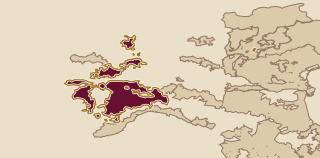
The Barolo DOCG occupies a cluster of eleven communes in the Langhe hills south of Alba, in the southern part of Piemonte. Nebbiolo grown here earns the Barolo appellation label; the grape is the only variety permitted in the red wines that carry it. Castiglione Falletto, where the cooperative is based, sits at the eastern edge of the zone on soils with higher calcium content, which tends to produce Barolo with firmer tannin and longer ageing potential.
The eleven communes stretch from La Morra and Barolo in the west, where soils are more Tortonian marl and clay, to Serralunga d'Alba and Castiglione Falletto in the east, where the geology shifts toward Helvetian limestone and compact clay. The difference in soil type between these two ends of the appellation is one of the most discussed contrasts in Italian wine, and Terre del Barolo has member vineyards at both ends.
In the cellar
Vineyards and cellar
The 600 hectares farmed by member growers span the full geographic range of the Barolo DOCG, from the western communes to the eastern edge at Castiglione Falletto and Serralunga. The cooperative applies certified environmental procedures in both vineyard and cellar operations.
For the Barolo Undicicomuni, Nebbiolo ferments in temperature-controlled tanks at 28 to 30 degrees Celsius, in contact with the skins for approximately 13 days. That maceration period extracts the colour, tannin, and aromatic compounds that give Nebbiolo its characteristic grip and aromatic range before the wine moves to oak for ageing. Thirteen days is a measured extraction: long enough for tannin and colour depth, short enough to avoid over-extraction from a grape that can turn hard and astringent with excessive skin contact.
Wines to know
The range in view
Barolo Undicicomuni is the cooperative's primary statement: 100% Nebbiolo, Barolo DOCG, drawn from all eleven communes and produced at around 50,000 bottles annually. It is the only Barolo in the range documented in full from fermentation through sensory profile. The wine is sold under both the Cantina Terre del Barolo name and the Arnaldo Rivera label.
Barbera d'Alba occupies the everyday tier: medium body, mellow tannins, and acidity that persists through the finish. Where Nebbiolo demands time, Barbera offers earlier access, and the lower tannin makes it a different kind of wine to drink alongside food.
A useful way in
A bottle to begin with
Barolo Undicicomuni 2019. This is 100% Nebbiolo fermented from vineyards in all eleven Barolo communes, produced at around 50,000 bottles a year. The nose carries spiced cedar, leather, and scorched earth. The palate runs from crushed raspberry and figs through cinnamon and star anise, with the dry, firm tannin that Nebbiolo builds from calcareous Langhe soils. It is not a soft or immediately approachable bottle. Nebbiolo from Barolo takes time to settle, and this one will reward patience. Start here to understand what a cooperative drawing from every village in the zone produces when it puts all eleven communes into a single wine.