
Why it matters
The producer
Mamoiada is a village in Sardinia's mountainous Barbagia interior, better known outside the island for its ancient carnival masks than for wine. Francesco Sedilesu spent more than twenty years in the wine trade before he and his three sons founded Cantina Teularju there in 2017 and planted eight hectares of Cannonau on granite slopes above 700 metres. They divided those eight hectares into four named plots, each called a Ghirada, a Sardinian term for a distinct land parcel with its own character. From the first 2019 harvest, the family bottled each Ghirada separately.
Francesco Sedilesu's decision to farm his own land in Mamoiada rather than continue in the broader wine trade was a considered departure. The Sedilesu family chose altitude and granite over the more accessible zones of Sardinian Cannonau production, and they chose to farm organically from the outset with spontaneous fermentation rather than commercial yeast. Both decisions slowed things down: organic farming requires more time in the vineyard, and spontaneous fermentation gives the winemaker less control over timing and temperature.
Place and vineyards
Where the wines begin
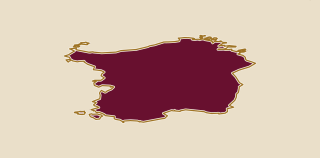
Barbagia occupies the mountainous centre of Sardinia, a territory of granite, scrub oak, and altitude that separates the island's coast from its inland plains. Mamoiada sits within it at over 700 metres, where summers are warm by day and cold at night, and that temperature swing through the growing season slows ripening and locks acid and aromatic freshness into the grapes. Cannonau grown here does not accumulate alcohol and weight the way it does at lower elevations near the coast.
The legal container for Teularju wines is either Cannonau di Sardegna DOC, where appellation rules govern Cannonau planted across the island, or IGT Sardegna, which gives the family more freedom in how they label and present individual Ghirada bottlings. Both labels appear in the range depending on the wine.
In the cellar
Vineyards and cellar
The eight hectares are farmed organically throughout, with spontaneous fermentation used for every wine in the range. Spontaneous fermentation relies on wild yeasts present on the grape skins and in the cellar, rather than inoculated commercial strains. It takes longer, runs less predictably, and tends to produce wines with more textural complexity and aromatic variation between vintages. The decision to use it across all four Ghirada rather than reserve it for a premium tier says something about the family's priorities: the method applies to the whole estate, not just the flagship.
Aging vessel type and duration are not publicly confirmed for any wine. The pale ruby colour and the freshness of the tannins in the Barbagia Rosso suggest extended oak contact is not part of the approach, but no official vessel details are available.
Wines to know
The range in view
The range has five wines, all from Cannonau.
Cara'Gonare is the estate's single-Ghirada benchmark, scored 94+ by Galloni in 2025 and named the best wine in Sardinia that year. One of the two plots bottled in the inaugural 2019 vintage.
A useful way in
A bottle to begin with
Start with the Barbagia Rosso. It draws from all four Ghirada and gives a clear account of what Mamoiada Cannonau at altitude tastes like before the single-plot distinctions come into view. The wine is pure ruby, medium-bodied, and built on wild strawberry, cranberry, and rose petal, with bright acidity, refined tannins, and a long granite finish. It scored 91 points from Galloni. Once it is in the glass, the four single-Ghirada wines become the natural next step: the same grape, the same farming, four different plots, four distinct answers.